
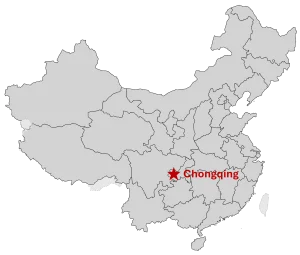
Are you ready for a city that challenges all your senses simultaneously? Chongqing is no ordinary place. It’s a vertical labyrinth where trains run through residential buildings, the ground beneath your feet is suddenly the roof of a skyscraper, and the scent of fiery chili hangs in every alley. This megacity is so delightfully unconventional, trendy, and full of contrasts that you will love it. In this article, I’ll show you the best sights in Chongqing, so you’re perfectly equipped for your own adventure between the Yangtze and Jialing.
Chongqing: Where the City Itself Becomes a Sight
Before we get to the individual sights and activities, let me tell you one thing: in Chongqing, the journey is the destination. The city is built on steep hills and literally squeezed between the major rivers. The result is a futuristic skyline. In Chongqing, there is no classic “up” and “down.” It’s incredibly fun to just drift along the lively streets and between the high-rises, and often get lost. The three-dimensional architecture, paired with the pulsating, almost electrifying atmosphere, makes just walking around an adventure.
Does Chongqing Fit into Your Itinerary? My Rating:
Here you’ll find a quick overview of whether Chongqing and its sights are the best choice for your itinerary:
| Authenticity | 🍌🍌🍌🍌 (4/5) | Nature | 🍌 (1/5) |
| Crowds | 🍌 (1/5) | Budget | 🍌🍌🍌🍌 (4/5) |
| Accessibility | 🍌🍌🍌🍌 (4/5) | Lifestyle & Entertainment: | 🍌🍌🍌🍌🍌 (5/5) |
| History & Culture | 🍌🍌🍌 (3/5) | Photogenic | 🍌🍌🍌🍌 (4/5) |
The Best Sights in Chongqing
Time Travel Between Skyscrapers: Chongqing’s Fascinating Old Town
Although Chongqing is considered a hypermodern cyberpunk metropolis today, a historical heart still beats deep within it. The contrast of discovering historical and traditional quarters again and again amidst the many high-rises makes these sights particularly appealing.
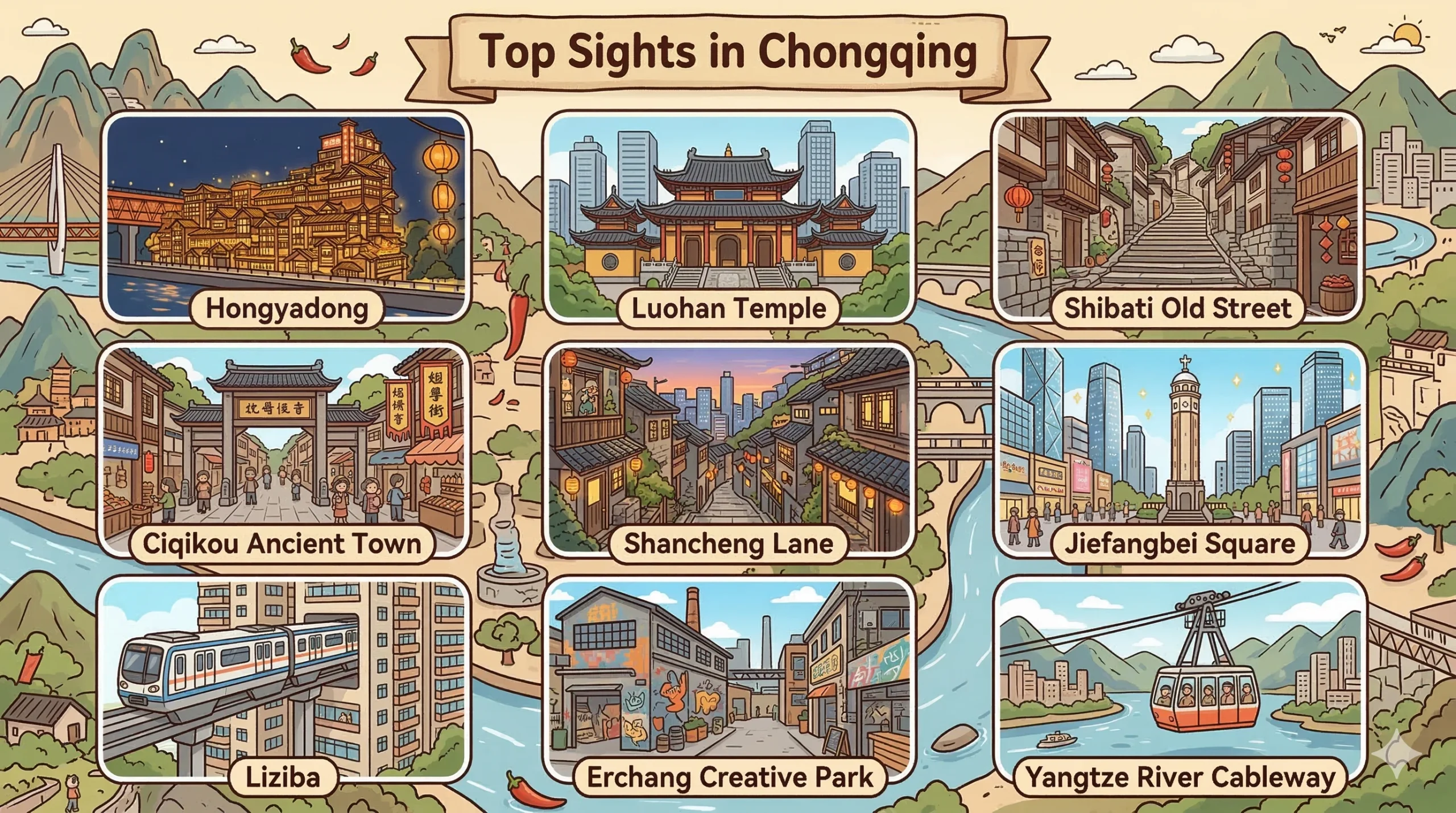
Hongyadong (洪崖洞, Hóngyádòng): If there’s one place you absolutely cannot miss, it’s Hongyadong. Located directly on the steep bank of the Jialing River, traditional stilt houses cling to the hillside in eleven stories. At night, the area transforms into a golden sea of lights. My tip: You get the absolute best view of this spectacle from the Qiansimen Bridge (千厮门大桥, Qiānsīmén Dàqiáo). But be warned: it gets extremely crowded here in the evening.
Luohan Temple (罗汉寺, Luóhàn Sì): Amidst the glittering Jiefangbei business district, hemmed in by modern skyscrapers, lies the Luohan Temple. This over 1,000-year-old Buddhist temple is a fascinating example of Chongqing’s contrasts. As soon as you step through the gates, you leave the noise of the megacity behind. The deep spirituality of this temple amidst the skyscrapers deeply impressed me. Here, you can also visit the Hall of the 500 Arhats (holy Buddhists), whose life-sized terracotta sculptures all have individual facial features and poses.
Shibati Old Street (十八梯, Shíbātī): Shibati Old Street is the epitome of “old” Chongqing, connecting the upper city center (Upper City) via steep stone steps with the lower riverbank. The name literally means “Eighteen Steps,” which seems almost like a joke considering the hundreds of steps! Here, you get a feel for what life in the city was like before the first high-rises conquered the sky. It’s the perfect place to explore Chongqing’s vertical structure on foot. Unfortunately, most shops here are now very touristy.
Ciqikou Ancient Town (磁器口, Cíqìkǒu): Only a short subway ride from the center lies Ciqikou, the “Porcelain City.” This historical district on the banks of the Jialing River was once an important center for porcelain production during the Ming and Qing Dynasties. Today, the quarter with its narrow, paved alleys and classic architecture conveys a good impression of what a traditional suburb of Chongqing used to look like. Ciqikou is unfortunately also very touristically shaped by now. The big plus point compared to the more centrally located Shibati Old Street, however, is that it’s a bit less crowded here.
Shancheng Lane (山城巷, Shānchéng Xiàng): If you’re looking for original Chongqing away from the glittering malls, Shancheng Lane is my personal favorite. This historical path winds along the old city wall up a steep cliff. Up here, time seems to run a little slower, and this old quarter seems slightly less crowded to me than Shibati and Ciqikou. You stroll past traditional stone houses that today house small shops of local artists and trendy cafes. One of my highlights in Chongqing is the Shancheng Path (山城步道, Shānchéng Bùdào) with the floating walkway fixed directly over the abyss on the cliff. From there, you have an impressive view of the Yangtze and the city’s bridges.
The Manhattan of the East: Chongqing’s Modern Skyline
Jiefangbei Square & Pedestrian Street (解放碑, Jiěfàngbēi): The pulsating heart of Chongqing beats at Jiefangbei Square. Around the historic Liberation Monument extends a huge pedestrian zone lined with glittering shopping malls and luxury brands. It’s the perfect place to absorb modern city life and look for street food in one of the many side streets. Here, you feel Chongqing’s energy particularly intensely – loud, bright, and always in motion.
Raffles City Chongqing (来福士广场, Láifúshì Guǎngchǎng): The architectural design of this building complex is intended to reminiscent sailing ships and houses a huge shopping mall. Standing out is the “Crystal” – a horizontal skyscraper that connects the towers at a height of 250 meters. Raffles City is the symbol of hypermodern Chongqing. The preceding Chaotianmen Square (朝天门广场, Cháotiānmén Guǎngchǎng) is located exactly at the uttermost tip of the peninsula, right where the yellowish-brown Yangtze and the greenish Jialing River meet.
Yangtze River Cableway (长江索道, Chángjiāng Suǒdào): An absolute classic among the best sights in Chongqing is the ride on the cable car over the Yangtze. Formerly an important means of transport for locals, the Yangtze River Cableway is a sight today. As the gondola glides over the water, you have a fantastic view of the skyline and the dense development on the banks.
Kuixing Square (魁星楼, Kuíxīng Lóu): Kuixing Square is the place where you can best experience Chongqing’s vertical architecture. You stand on a wide square, look over the railing, and suddenly realize that you are on the 22nd floor of the neighboring building, while normal street traffic flows deep beneath you. This multi-story urban planning is absolutely crazy and makes the square one of the most fascinating photo spots.
Erchang Creative Park (二厂文创园, Èrchǎng Wénchuàng Yuán): This former power plant is today an alternative quarter for artists. Between old brick facades and rusty steel structures, you’ll find stylish cafes, design shops, and plenty of urban art. Creative energy flows here today instead of electrical energy.
Liujia Pier (刘家码头, Liújiā Mǎtóu): For one of the best views of the inner city skyline, you should go to Liujia Pier. While many tourists crowd near Hongyadong, this spot on the opposite bank offers a fantastic perspective of the illuminated skyline.
Liziba Viewing Platform (李子坝, Lǐzǐbà): You’ve guaranteed seen this place on social media: Liziba Metro Station, where the train runs right through an inhabited high-rise. From the specially built viewing platform below the tracks, you can take the perfect video when the train disappears into the building.
Culinary Highlights: Spicy, Spicier, Chongqing
A trip to Chongqing is not complete without the food. The city is world-famous for its Hot Pot (火锅, Huǒguō). It’s more than just a meal; it’s a social event where you dip meat and vegetables into a bubbling cauldron seasoned with Sichuan pepper and chili.
Those who prefer it faster should definitely try the local Chongqing Noodles with chickpeas (碗杂面, Wǎn Zá Miàn). These spicy noodles are the breakfast of champions here. In the evening, countless night markets beckon with street food offering everything from grilled skewers to sticky rice cakes.
The Best Excursions and Sights Around Chongqing
If you bring a little more time, the surrounding area offers spectacular UNESCO World Heritage sites and natural wonders:
Wulong Karst National Geopark (武隆喀斯特, Wǔlóng Kāsītè): About 3 hours away, monumental “Three Natural Bridges” and deep gorges await you.
Dazu Rock Carvings (大足石刻, Dàzú Shíkè): Over 50,000 religious sculptures from the 9th to 13th centuries – an absolute must for culture fans.
Fengdu Ghost City (丰都鬼城, Fēngdū Guǐchéng): A huge temple complex on the Yangtze. Here you wander through palaces and over bridges symbolizing the transition to the underworld, lined with artistic statues of demons and ghost judges.
Snowy Jade Cave (雪玉洞, Xuěyù Dòng): Snowy Jade Cave is considered one of China’s most spectacular white karst caves. What makes it so special is the purity of its formations – the stalactites and stalagmites shimmer here in an almost flawless white reminiscent of freshly fallen snow or precious jade.
Diaoyu Fortress (钓鱼城, Diàoyú Chéng): A historical fortress in Hechuan that defied the Mongols in the 13th century.
Geleshan National Forest Park (歌乐山, Gēlèshān): Ideal for a short break in the countryside with hiking trails and waterfalls, only an hour from the center.
My Conclusion: Why Chongqing’s Sights Will Thrill You
For me, Chongqing is the city in China that “vibrates” the most. This city challenges your sense of orientation and rewards you with views you won’t find anywhere else in the world. I love coming here to experience modern and alternative China. Chongqing is loud, spicy, and chaotic. A very unique combination that makes this city so special.
I hope this overview of the best sights in Chongqing has inspired you to plan your own trip into this vertical world. You won’t regret it!
1 thought on “Best Sights in Chongqing: China’s Cyberpunk City”