
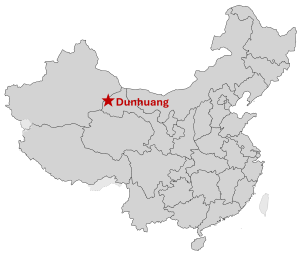
The Mogao Caves (莫高窟, Mògāokū) in Dunhuang left a deep impression on me. This site is the result of a thousand-year history, yet it hardly appears on the tourist map of many individual travelers. In few other places can you experience the history and significance of the Silk Road as directly as here. Today, I want to show you why the Mogao Caves are unfairly overlooked and help you plan your own trip there.
Tips for Planning and Arriving at the Mogao Caves
It is highly recommended to buy your tickets in advance, as the amount of tickets each day is limited. When purchasing tickets, you generally have two options:
- Third-party providers: You can book in advance via platforms like trip.com (External Affiliate Link), which offers a convenient English user interface.
- Official WeChat Mini-App: To avoid third-party service fees, you can book directly via WeChat. Simply enter the Chinese name 莫高窟 (Mògāokū) into the WeChat search bar.
Entrance Fee: The price is 258 RMB (approx. €33) per person. This includes a guided tour of eight selected caves as well as two very well-produced films at the visitor center that introduce you to the history beforehand.
Entry is managed through a large visitor center. It is located quite close to the center of Dunhuang (敦煌, Dūnhuáng) and is easily reached in about 15 minutes by taxi (Didi). If you are arriving with a rental car, you will find a large parking lot on-site. After the ticket check, shuttle buses will take you on a 20-minute drive through the desert landscape to the actual caves.
The caves can only be visited as part of a guided tour. English-speaking tours are offered daily. Since these are often in much lower demand than the Chinese tours, we were incredibly lucky: we were actually alone! Our motivated guide gave us what was essentially a private tour, which provided us with completely different insights. I am still very grateful for that moment.
Will you like the Mogao Caves in Dunhuang? My Rating:
Here is a quick overview to help you decide if the Mogao Caves are the right choice for your trip to Dunhuang:
| Authenticity | 🍌🍌🍌🍌 (4/5) | Nature | 🍌🍌 (2/5) |
| Crowds | 🍌🍌 (2/5) | Budget | 🍌🍌🍌 (3/5) |
| Accessibility | 🍌🍌🍌 (3/5) | Lifestyle & Entertainment: | 🍌 (1/5) |
| History & Culture | 🍌🍌🍌🍌🍌 (5/5) | Photogenic | 🍌🍌 (2/5) |
What to Expect: 45,000 Square Meters of Murals and 30-Meter-High Statues
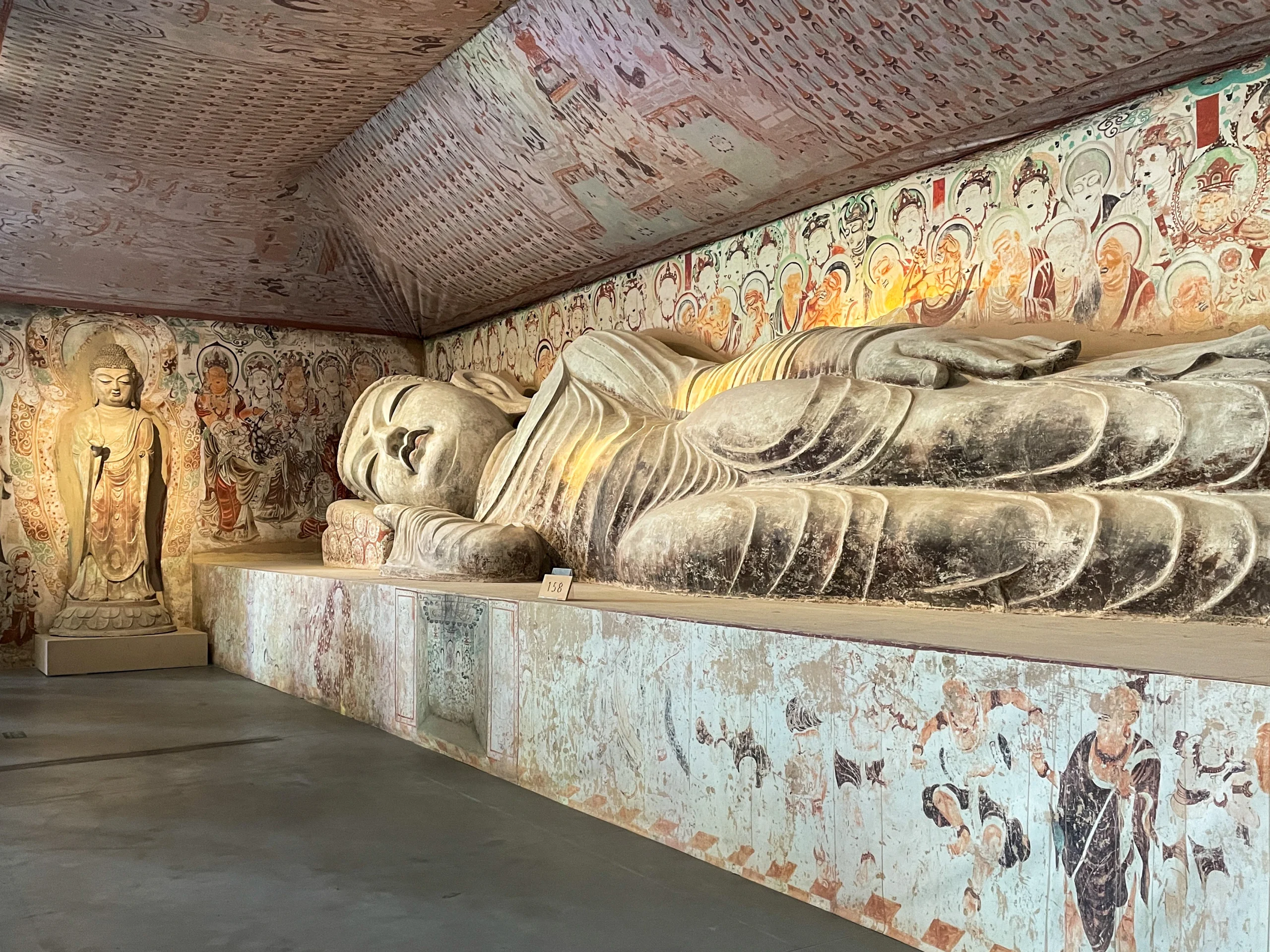
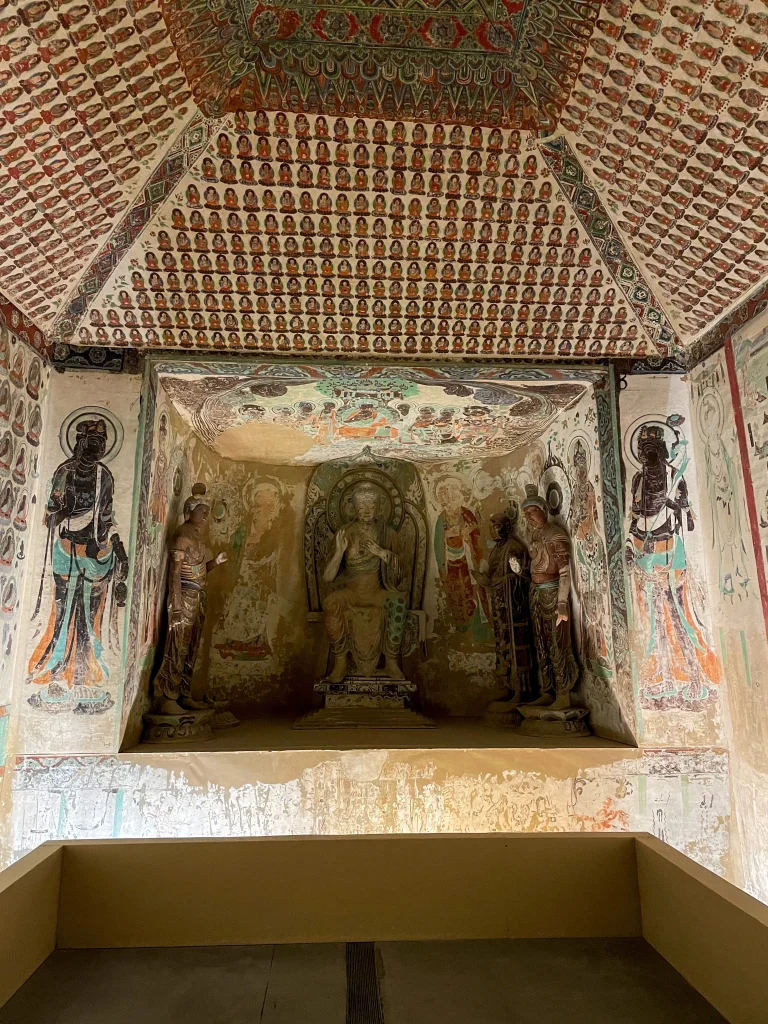
The Chinese reverently call the place Mogaoku (莫高窟), which translates to “Peerless Caves.” Standing in front of the high rock face, it quickly becomes clear why. The entire complex actually consists of about 700 to 1,000 caves, which continue to be researched today. 492 caves are preserved and accessible. These house 2,415 hand-painted sculptures and over 45,000 square meters of vibrant murals.
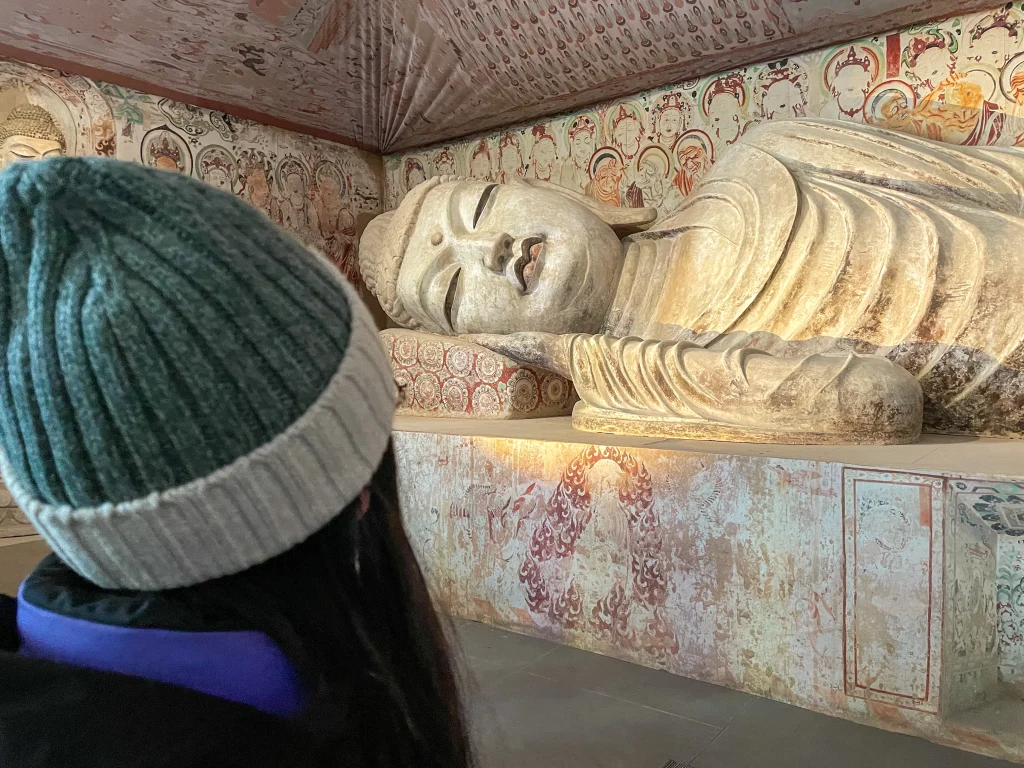
Because access is strictly controlled, you will visit eight selected caves as part of the standard tour. I was particularly struck by how unique each cave is. Some are small and intimate, filled with the finest drawings, while others house massive Buddha statues spanning several stories. Especially famous is the seated Maitreya Buddha (弥勒佛, Mílèfú), which stands over 30 meters tall and is one of the largest clay figures in the world. When you realize that the tour only shows a very small section of the complex, it is all the more impressive to imagine the scale this pilgrimage site must have reached in the past.
Don’t be surprised by the darkness: there is no electric light in the caves to prevent the mineral colors from fading. The guides use flashlights to highlight details. There is also a strict ban on photography inside.
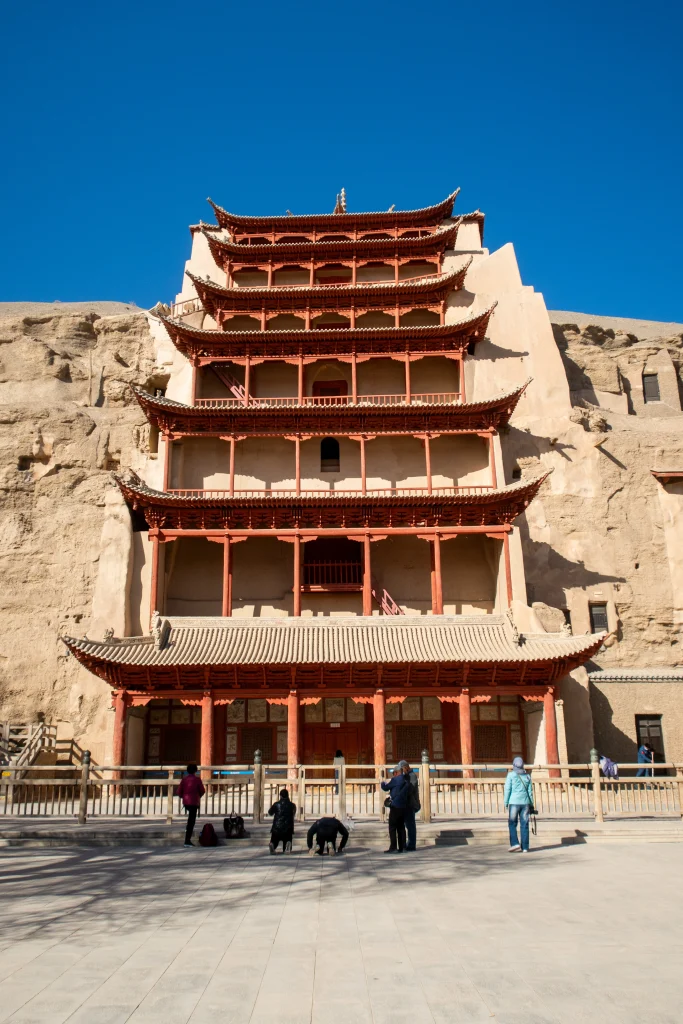
The Mogao Caves in Dunhuang: 1,600 Years of History
The Mogao Caves are located in the historic Hexi Corridor (河西走廊, Héxī Zǒuláng) in northwest China. This narrow passage, bordered by deserts and mountains, was part of the Silk Road. The oases near Dunhuang served as an essential rest stop on the long journey through the desert.
According to legend, the story began in 366 AD. A Buddhist monk named Le Zun was crossing the Gobi Desert and rested at Sanwei Mountain (三危山, Sānwēi Shān). At sunset, he suddenly saw a vision of a golden Maitreya Buddha glowing in the sky. Deeply moved, he decided to stay and carve the first cave into the rock. Over the next nearly 1,000 years (4th to 12th century), monks, artists, and officials continually added more caves, creating this massive complex.
In the diverse caves, a depiction of Buddha is usually the central component. The various artistic styles are fascinating; one can recognize Indian and Central Asian influences merging with Chinese characteristics—important evidence of the cultural exchange along the Silk Road.
After the Silk Road lost its significance in the 14th century, the caves were nearly forgotten and swallowed by the desert sand. It wasn’t until 1900 that the Taoist monk Wang Yuanlu discovered the so-called “Library Cave” (Cave 17). It contained about 50,000 documents that had been walled up to protect them from the invading Mongols. Unfortunately, a large portion of these valuable writings was taken out of the country by European archaeologists in the early 20th century. Many of these relics are now held in the British Museum in London.
My Conclusion: An Impressive Journey Through Time on the Silk Road
For me, the Mogao Caves in Dunhuang were one of the absolute highlights of my travels in China. If you are interested in culture and want to leave mass tourism behind for a while, Dunhuang is the perfect place. The caves are rightfully a UNESCO World Heritage site today and are just waiting to be discovered by you.
Are you currently planning your route through China or do you have questions about booking via WeChat? Feel free to write to me in the comments—I look forward to exchanging ideas with you!
1 thought on “The Mogao Caves in Dunhuang: A Forgotten Jewel of the Silk Road”