
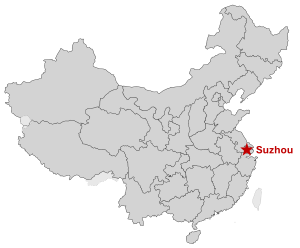
Suzhou is a popular travel destination in China and happens to be one of my absolute favorites. But there is so much more behind those picturesque canals and gardens than just a pretty backdrop. The city of Suzhou looks back on a vibrant history spanning over 2,500 years. In this article on the history of Suzhou, I want to give you an overview of all the background information that is helpful and exciting for travelers to understand. Join me on a discovery tour from its martial beginnings to its time as the elegant silk capital.
The Birth of Suzhou: The History of the Kingdom of Wu
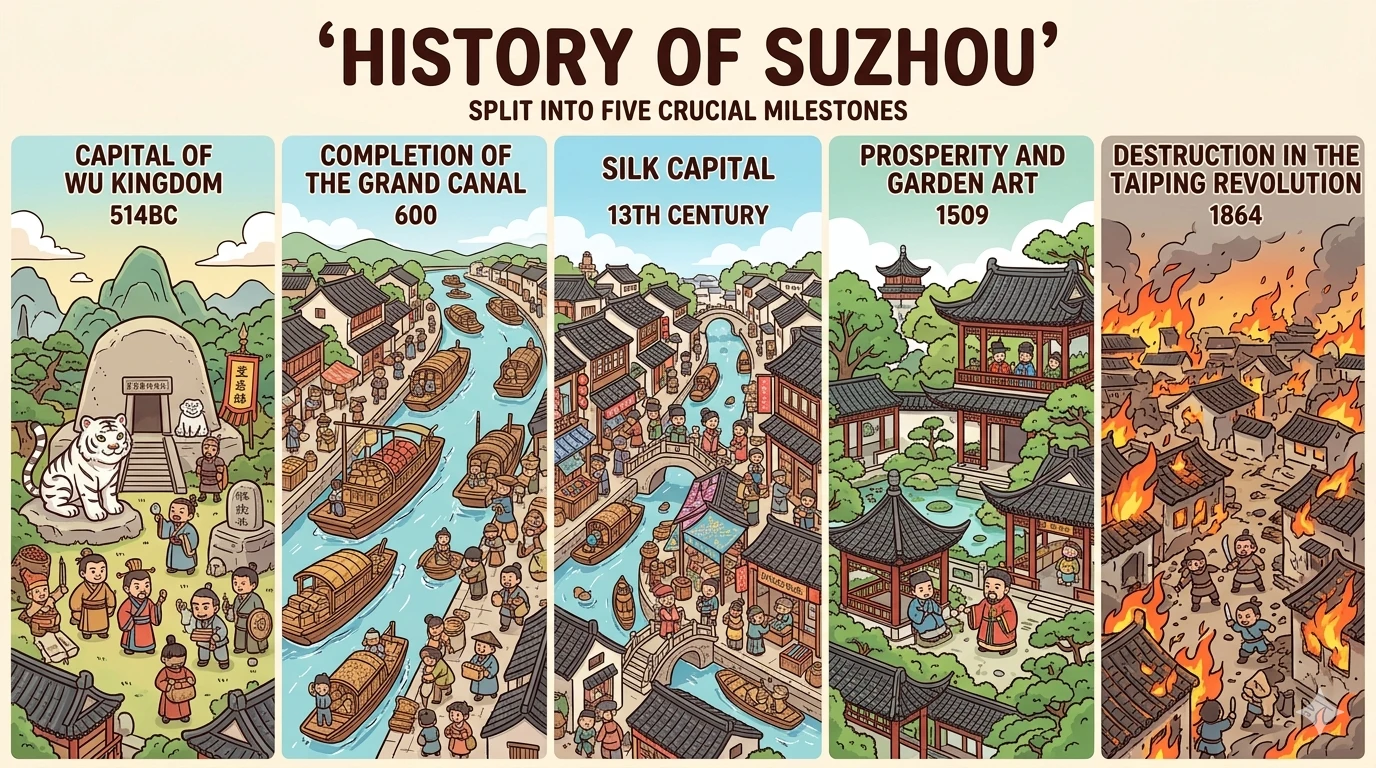
It all began in 514 BC. Under King Helu, the city was founded as Wucheng and quickly rose to become the capital of the Kingdom of Wu. In 496 BC, King Helu was buried in Suzhou at Tiger Hill (虎丘, Hǔqiū). Today, this site is preserved as an extensive park and temple complex and is well worth a visit. By the way, the name of this hill is linked to a legend: it is said that just three days after the King’s burial, a white tiger appeared on the hill to guard the grave.
The early days were turbulent. Shortly after Suzhou was established as the capital of the Wu Kingdom, it was conquered by the Kingdom of Yue, followed by the Kingdom of Chu. What remains from this stormy era is the impressive city wall. A particular highlight is the Pan Gate (盘门, Pánmén). Back then, it was already the only city gate of Suzhou and has been preserved in an altered form to this day.
Did you know that the city wall even has a secret culinary ingredient? A curious legend claims that sticky New Year’s cake (年糕, niángāo) was built into the foundations during times of crisis as a type of “cement” or hidden provisions. If the city was besieged, the inhabitants literally had an iron (or rather, sticky) reserve in the wall!

Suzhou’s Rise via the Grand Canal
A decisive turning point for the history of Suzhou was the completion of the Grand Canal around the year 600 during the Sui Dynasty. This massive trade route heading north, with Suzhou situated at its southern start, brought a huge boom to the city as a hub for trade and goods. It was during this time that Suzhou received its current name. Parts of the Grand Canal can still be found in Suzhou today.
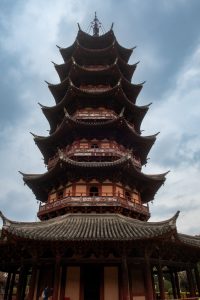
Around the year 825, the Shantang Canal (山塘街, Shāntáng Jiē) was constructed. For that period in history, it had a very modern goal: it was intended to connect the city center of Suzhou with Tiger Hill, primarily for travelers and tourists. Until today, the canal serves exactly that purpose and remains one of the most atmospheric spots in the city. During the same period, in 907, construction began on the famous Yunyan Pagoda (云岩寺塔, Yúnyán Sì Tǎ), which is known today as China’s “Leaning Pagoda” and can still be visited on Tiger Hill.
Suzhou’s Golden Age: Silk, Gardens, and Marco Polo
By the 13th century, Suzhou had long been world-famous as the “Silk Capital” of the Empire. Even today, countless silk and Qipao shops define the look of the old town. Even Marco Polo was so impressed during his visit in 1276 that he reportedly described the city as “magnificent,” laying the foundation for its reputation as the “Venice of the East.” Thanks to direct access to the sea via the Wusong River and Suzhou Creek during this time, trade flourished until siltation in the Yangtze Delta later made direct sea access more difficult.
The aesthetic golden age reached its peak in 1509 with the creation of the Humble Administrator’s Garden (拙政园, Zhuōzhèng Yuán). It is considered the ultimate model of Chinese garden art. Alongside the still-flourishing silk industry, Suzhou also became a center for banking, embroidery, and the high society of ancient China. Suzhou was famous for producing the country’s highest number of graduates from the imperial civil service examinations. This explains the abundance of private gardens, as many retired high-ranking officials returned here to devote themselves to art and gardening.
Stagnation and Destruction
In 1356, Suzhou once again became the capital of the Kingdom of Wu, only to be conquered again 20 years later in 1367 by Zhu Yuanzhang, who later became the first Emperor of the Ming Dynasty. During and after his siege, he had parts of the historic city walls torn down.
Suzhou was also heavily damaged during the Taiping Rebellion (1850–1864). It was only in the aftermath of this destruction that Suzhou lost its supremacy in the region and was gradually replaced as the economic center by the rising neighbor, Shanghai. Find out more on the history of Shanghai in my separate article.
Throughout all this, Suzhou remained remarkably true to its identity as a traditional water town: well into the 20th century, Suzhou was not a contiguous land-based city. Instead, the city consisted of several islands connected by canals and lakes.
After World War II, the restoration of many historic sites began in 1950. A true miracle occurred in 1978: children at play accidentally discovered a hidden wall chamber in the Ruiguang Pagoda (瑞光塔, Ruìguāng Tǎ) near Pan Gate. Hidden inside was a priceless Buddhist treasure from the 10th century, which had waited there for over a thousand years to be discovered.
To preserve the atmosphere of the many historic sites, buildings in the old town today are not allowed to exceed a height of 24 meters. Skyscrapers and most apartment blocks are therefore located in newer districts, which gives Suzhou’s old town its historical flair to this day.
My Personal Conclusion: the History of Suzhou as the Key for Travelers
For me, the history of Suzhou is the actual key for travelers to not just see this city, but to truly feel it. Before I dived deeper into the background, Suzhou was “just” a beautiful city with canals to me. But since learning about the historical context, I experience every temple and every garden much more intensely.
I was particularly fascinated by the realization that for the longest time in history, it wasn’t the modern metropolis of Shanghai, but Suzhou that was the true cultural and industrial heavyweight of the region. By comparison, Shanghai was almost insignificant for a long time, while the fate of kingdoms was already being decided in the alleys of Suzhou and the finest silk in the world was being produced. When you stroll through the old town today, you can feel that former glory of a world metropolis at every corner—a city that has preserved its elegance over millennia.
Has this article inspired you to take a trip to Suzhou? Here you can find the complete overview for planning your trip to Suzhou. Did any historical fact particularly surprise you? Let me know in the comments—I’m really looking forward to the exchange and hearing your own impressions!
1 thought on “Suzhou and Its History: An Overview for Travelers”