
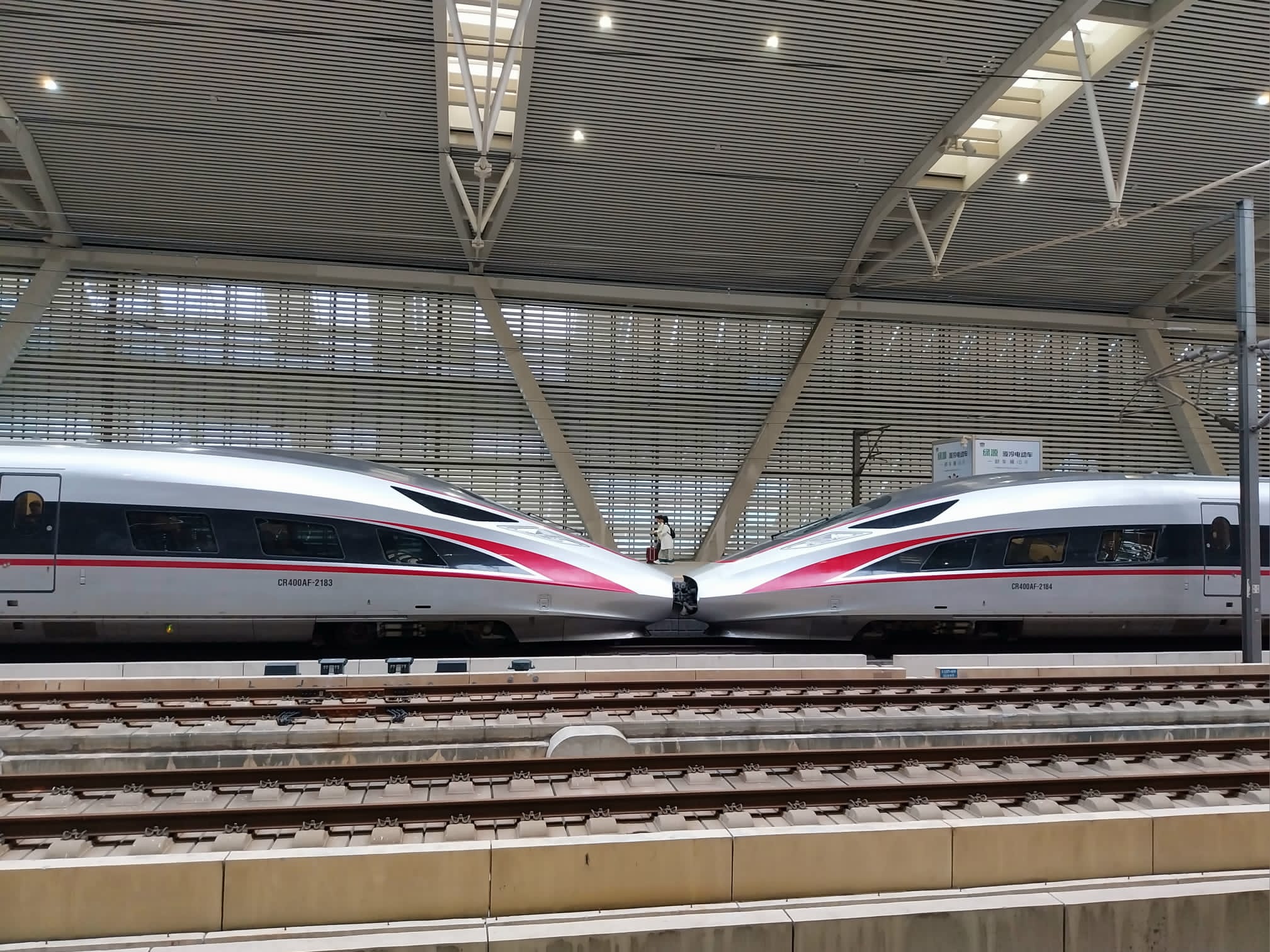
If you are planning your first trip to China, the topic of transportation often presents a challenge. I can reassure you: train riding in China is incredibly comfortable, efficient, and often even faster than a flight—if you know how it works. Taking the train in China is significantly different from what we are used to in Europe. The massive stations, the Chinese characters, and the strict controls can be a bit overwhelming at first. To ensure you don’t get lost in the system during your adventure, I have put together this guide to train riding in China. I’ll take you by the hand so that you can travel through China stress-free and reach your destination safely.
Before the Trip: Booking Tickets Early
The difference to Europe starts even before the actual journey. In China, train tickets are personalized and often sell out quickly. One important fact: tickets only go on sale 14 days before the date of travel. Especially on popular routes or before public holidays, you should strike right at the start of the booking window.
For booking your train tickets, you generally have two options:
- Third-party providers: This is the easiest variant for travelers. Providers like Trip.com (external affiliate link) offer English-language user interfaces and international payment methods. Another big advantage is that you can reserve tickets in advance. The provider then buys them for you automatically as soon as the official sales window opens. A small booking fee usually applies for this service.
- Official App: The official railway app (Railway 12306) now has an English user interface. Registration is a bit frustrating, but you pay the original price and can pay via Alipay or WeChat Pay.
In the Chinese rail network, there are different types of trains and booking classes. I definitely recommend using the high-speed train whenever possible. You can recognize high-speed trains by the train number starting with a G. These high-speed trains are not only the fastest but also the most comfortable. In terms of comfort, you also have a choice between several booking classes:
- 2nd Class: Comparable to 2nd class in European long-distance trains.
- 1st Class: Comparable to 1st class in European long-distance trains. More legroom and a bit more peace and quiet.
- Business Class: Comparable to business class on long-haul flights. The seats can be reclined completely flat like on a plane, you have a lot of privacy, and snacks are often included. A real experience that takes train riding in China to a new level! However, this booking class is also significantly more expensive than the standard seats.
At the Station: Scheduling and Security Checks
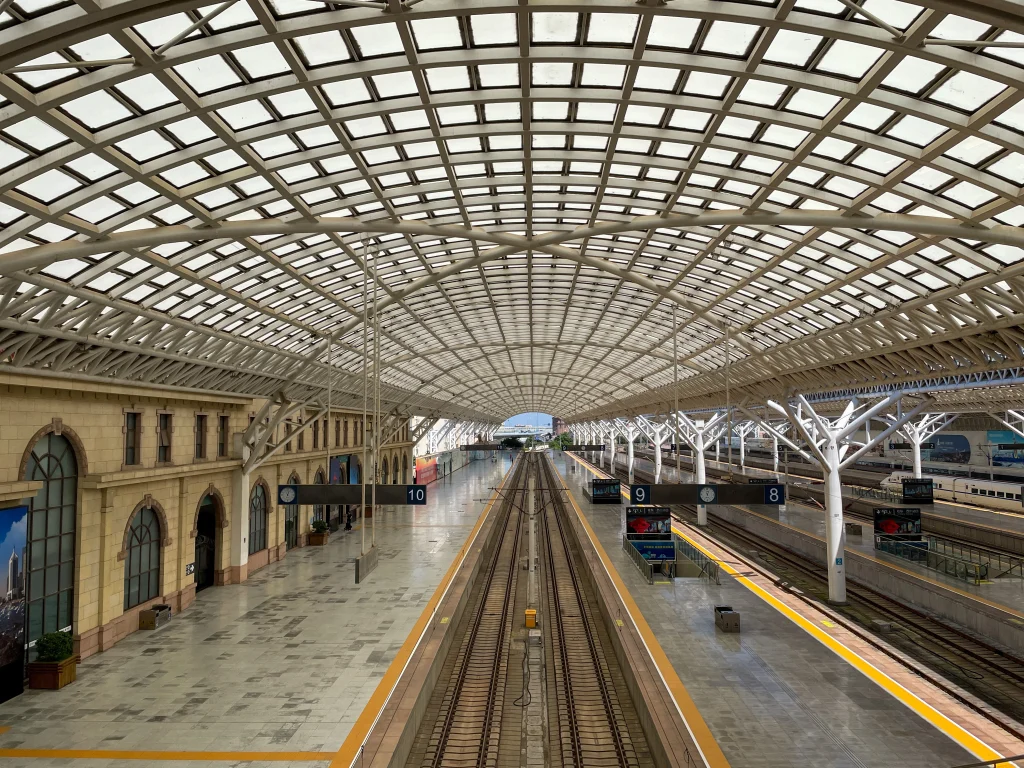
This is where the most demanding part of your journey begins: arriving at the station, finding your train, and ideally boarding the correct carriage. To ensure nothing goes wrong before riding the train, here is a short guide: Stations in China resemble modern airports more than classic European train stations. Plan to arrive at the station about 60 minutes, or at the latest 40 minutes, before departure.
Your most important document is your passport. You do not need a printed ticket, as your passport is stored in the system as your digital ticket. Upon entering the station, the first check takes place. Since the automatic gates often only read Chinese IDs, look for the manual counter with staff. After the ticket check, a security check of your luggage follows.
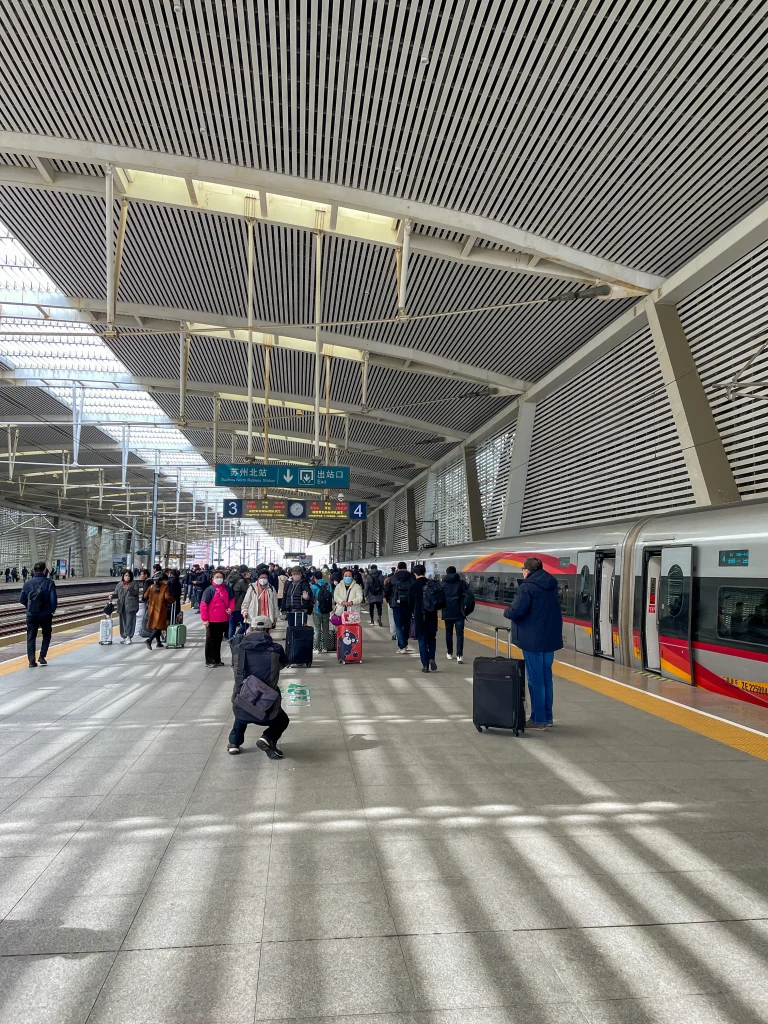
In the huge waiting hall, look for your train number on the display boards. Watch for the characters for platform/gate: 检票口 (jiǎnpiàokǒu – Ticket-Gate). In Chinese stations, however, you can only go to the track shortly before the train arrives—usually about 15 minutes before the scheduled departure. Therefore, line up at the correct ticket gate on time and wait for the start of the second ticket check.
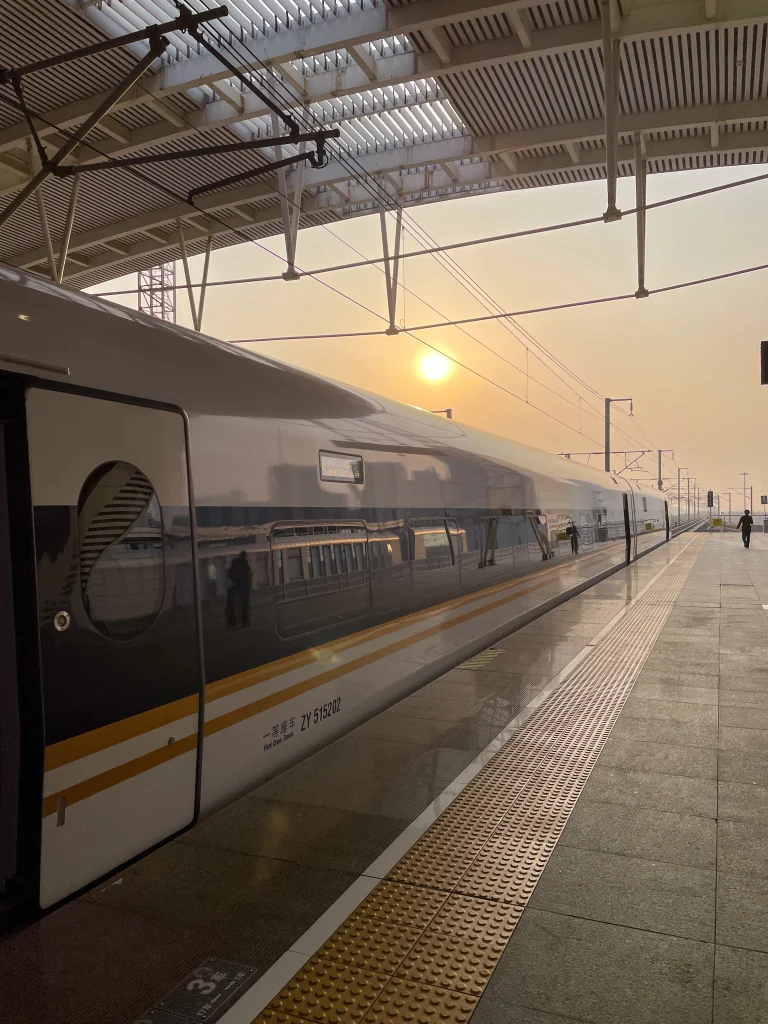
Once you reach the platform, the last challenge awaits: finding the right carriage. The trains are very long and the stopping time is short. Therefore, there are colored markings on the ground that indicate the car positions. Since the display of the current color for the train markings is often only in Chinese, it’s best to briefly ask a staff member on the platform—simply pointing to your carriage number on your phone is usually perfectly sufficient.
During the Journey: Service at Your Seat and High-Speed Feeling
As soon as you are seated, the relaxed part begins. Since tickets were already checked at the station, there are no further checks on the train itself. Nevertheless, make sure you sit in your reserved seat. Since reservations are mandatory in Chinese trains, confusion can otherwise arise quickly.
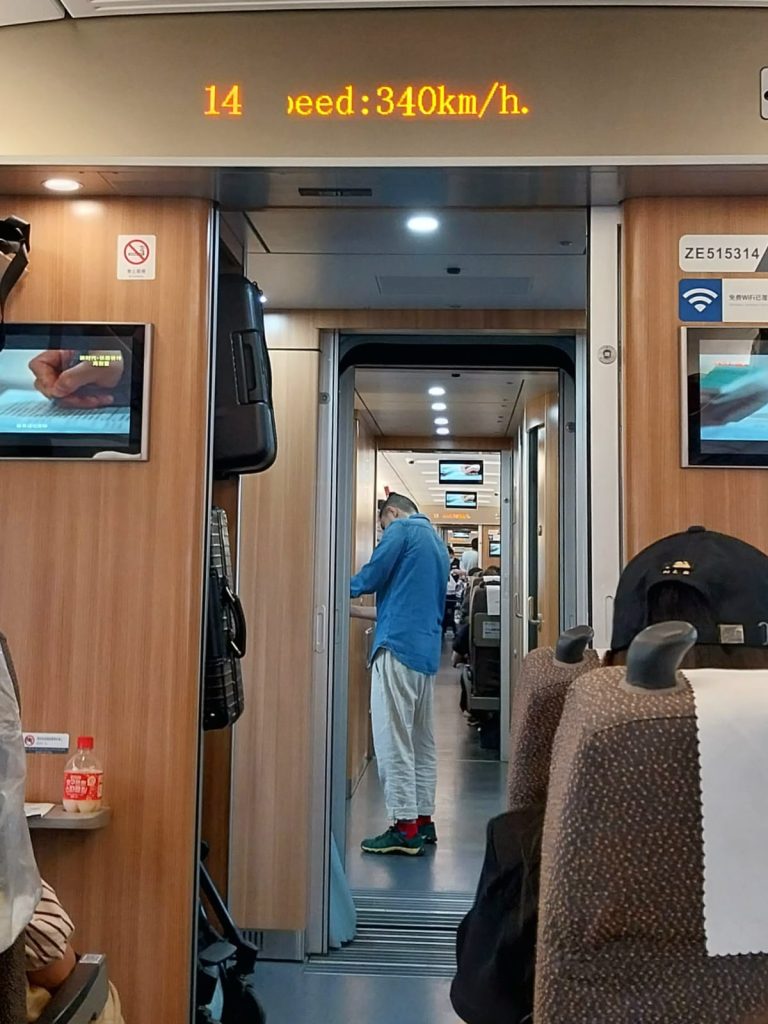
The trains run incredibly smoothly on the tracks, even when the display on the wall shows over 300 km/h. At every seat, you will also find a QR code. If you scan this with WeChat or Alipay, you can order drinks, snacks, and in some trains even a Starbucks coffee directly to your seat.
In some trains, there is even the possibility to order food from restaurants at the next station along the route. A railway employee brings your order onto the train at the next station. After departure, the train staff delivers the order directly to your seat. This way, you can even eat your favorite fast food during the train journey and are not limited by the selection in the onboard restaurant.
The only downside: network coverage is often unstable during the journey. It is best to download your movies or podcasts beforehand.
Arrival and “Train Hacks” for Emergencies
Upon arrival at your destination station, you must scan your passport one last time when leaving the station. Welcome to your destination!
But what to do if everything is sold out? Here is a guide for last-minute bookings when riding train in China:
The most important thing is that your starting station is part of your train booking. Sometimes a partial segment of your journey is still available. This gives you two options:
- Book an earlier starting station: You can buy a ticket with departure from an earlier station and then only board at your actual starting station.
- For example: You want to go from the water towns in Suzhou (苏州 Sūzhōu) to the Forbidden City in Beijing (北京 Běijīng): If tickets from Suzhou are sold out, check if there are still tickets from the starting station (e.g., Shanghai 上海 Shànghǎi). You can buy the ticket from Shanghai but board later in Suzhou.
- Book a later destination station: If your destination station is not available, buy a ticket to a stop before it. Simply stay on the train and pay the difference to the train staff later or at the special counter at your destination station. This isn’t exactly the most polite way, but it is accepted as long as you settle the difference.
- For example: You want to go from Beijing to Shanghai to see the stunning skyline at the Bund. If tickets to Shanghai are sold out, check if there are still tickets to an earlier station on the way (e.g., Suzhou).
My Personal Conclusion: Why I Love Train Riding in China
To be honest, I am fascinated every time by the efficiency of this system. It can be hectic at the station and the security checks take time, but once you are on the train, traveling by rail is very relaxed. I hope this guide to train riding in China helps you keep track of everything. For me, the train in China has become the number one mode of transport and is often even faster than the plane when you consider the travel to the airport and boarding. Personally, I certainly wish that we in Europe could take a leaf out of their book regarding this punctuality and efficiency.
Are you currently planning your first trip to China or have you already had experiences with the high-speed trains in China? Feel free to let me know in the comments—I look forward to exchanging ideas with you!
5 thoughts on “Train Riding in China: A Guide for Solo Travelers”