
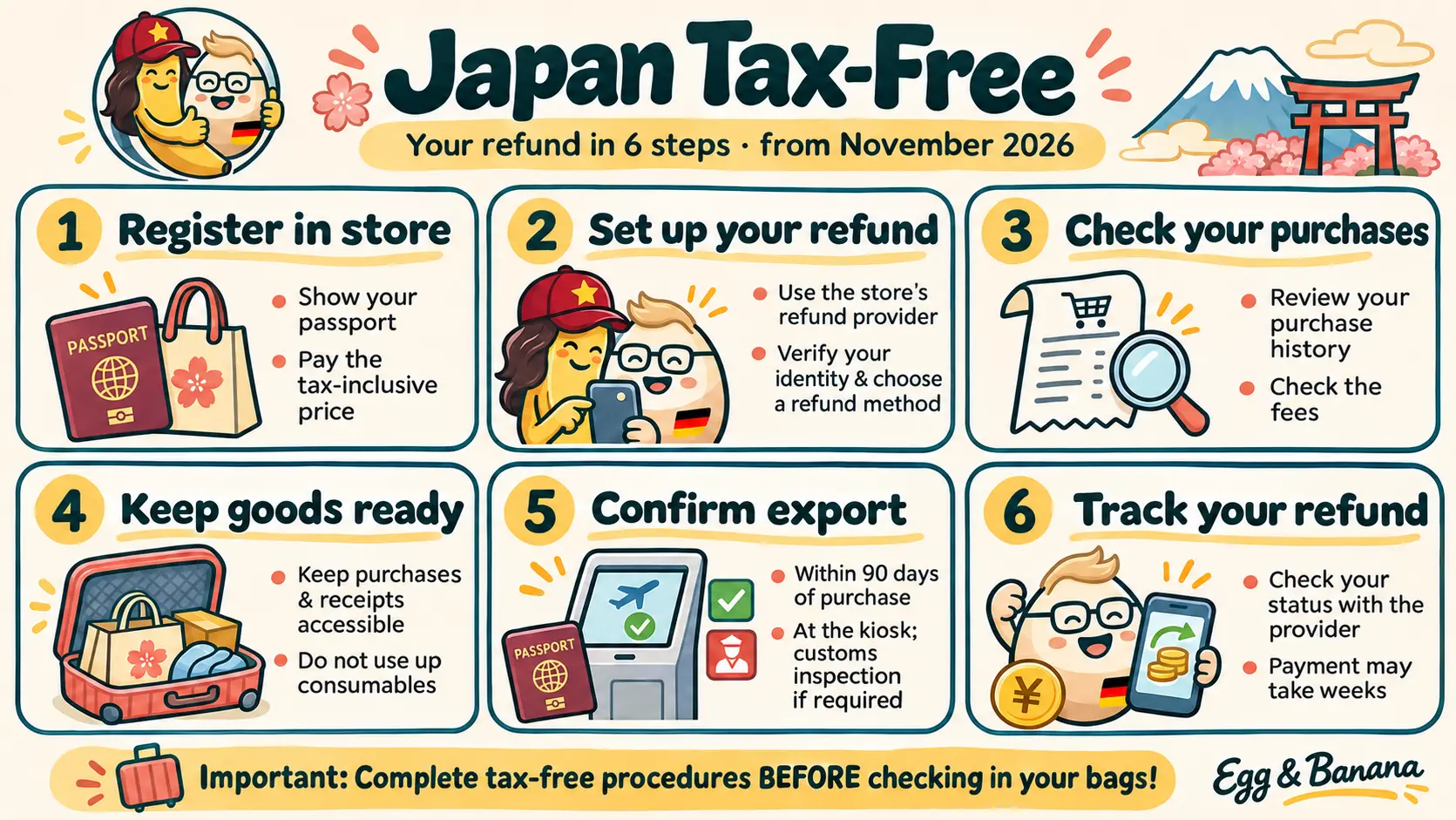
The tax-free rules of Japan changed significantly on 1 November 2026. You now pay for your purchases including Japanese consumption tax upfront. Only after your goods have been confirmed for export when you leave Japan does the shop or its refund provider arrange your refund.
We already miss the old system. Show your passport, pay the tax-free price or get the tax refunded right there in the shop: it couldn’t have been more convenient. The new process adds another step, although Japan has made it as straightforward as possible. In this article, I’ll walk you through the new tax-free rules in Japan, step by step.
What Is Changing with the Tax-Free Rules of Japan?
The key difference is that the tax exemption only takes effect after the checks when you leave Japan. One reason for the change of rules is to address cases where goods bought tax-free were resold within Japan instead of being taken out of the country. Above all, the refund is now tied to confirmed export.
| Until 31 October 2026 | From 1 November 2026 | |
|---|---|---|
| Payment | Tax-free purchase or refund at an in-store counter | Full price including tax paid upfront |
| Refund | Available at the time of purchase | After export confirmation |
| Departure | Taking the goods out of Japan yourself | Tax-free procedures before checking in your bags; within 90 days of purchase |
| Consumables | Special packaging and a separate purchase limit | Special packaging and the previous ¥500,000 upper limit abolished |
The new rules also remove the distinction between general goods and consumables. However, this does not mean you can automatically buy cosmetics or food tax-free to use during your trip: anything consumed in Japan is not eligible for a refund according to the rules.
Who Can Shop Tax-Free in Japan, and What Is the Minimum Spend?
For a typical trip, foreign visitors who do not live in Japan, entered with “Temporary Visitor” status and have been in the country for less than six months can benefit from the tax-free rules. A foreign passport alone does not automatically make you eligible.
The minimum spend is ¥5,000 excluding tax per shop per day. Your purchases must be intended for export, and you must be able to take all of them out of Japan with you.
We came across plenty of participating shops on our trip. Even so, look for the Tax-Free sign before shopping and check whether that particular branch offers the service. An ordinary receipt does not replace registering your purchase as tax-free.
Step by Step: How Japan’s New Tax-Free Rules Work
1. Register Your Tax-Free Purchase in the Shop
Tell the staff that you would like to shop tax-free and have your passport ready. Depending on the shop, the process takes place at the checkout or at a separate counter. The retailer needs to register your purchase accordingly. You initially pay the price including tax.
Our tip for couples: Decide beforehand whose name the purchase will be registered under. If you pay by card, use a card in the name of the person whose passport is being registered. Otherwise, you risk having your tax refund rejected later.
2. Set Up Your Refund Method
The shop will explain which provider handles your refund and how you will receive it. On our trip, J-TaxRefund was a common service used by many shops. However, it is not a mandatory central platform for all tax-free purchases in Japan. The refund options available vary by retailer.
With J-TaxRefund, it is worth registering before your trip to reduce the admin while you are on holiday. You need an account with an email address, passport-based identity verification and a registered refund method. You can get started at J-TaxRefund (external link).
3. Check Your Purchases and Fees
Check that your purchases appear correctly in the overview. If anything is missing or incorrect, try to resolve it with the shop before heading to the airport. Unfortunately, there is also a service fee. The J-TaxRefund FAQs explicitly confirm that you will not receive the full tax amount and that fees depend on your refund method.
4. Keep Your Goods Ready for Departure
Pack your suitcase so that you can easily show your registered purchases if you are inspected at the airport. Keep your receipts too.
Take particular care with consumables. If, for example, you start using a cream registered for tax-free shopping while still in Japan, or eat food you have bought, this may affect the entire purchase on the same receipt: if an item is missing, export cannot be confirmed for that transaction.
Our practical tip: Pay separately for snacks to eat on the go and cosmetics you intend to use during your trip, keeping them apart from your tax-free purchases.
5. At the Airport, Go to the Tax-Free Kiosk First
When leaving Japan, go to the tax-free kiosk in the international departures area before checking in your suitcase. The system scans or records your passport there. Export confirmation must be completed within 90 days of purchase.
The result displayed at the kiosk determines your next step:
- Green: No goods inspection is required; the customs procedure is complete.
- Red: Take your purchases to the designated customs inspection area and show them there.
A red result therefore means an inspection is needed, not that your refund has automatically been rejected. You can check in your bags afterwards. The queue we saw at the airport looked short and well organised. Still, allow some extra time, especially if you have lots of purchases in your suitcase.
6. Track Your Refund
After customs confirmation, the shop or its appointed provider issues the refund. Customs confirms the export; it is not automatically where you collect your money.
For example, J-TaxRefund states that processing can take a few weeks to around two months, depending on the method you choose. You can check your status on the home screen after logging in.
Frequently Asked Questions About Tax-Free Rules in Japan
Will I get my money back at the airport?
Not necessarily. Depending on the shop and provider, options may include card refunds, bank transfers, app-based payments or cash. J-TaxRefund also lists cash refunds at designated airport counters.
What if I have a connecting flight within Japan?
Complete the procedure at the airport from which you actually leave Japan. If your bags are due to be checked through at your first airport, speak to the airline before handing them over to confirm how your goods can remain available for a possible inspection at your international departure airport.
Can I use tax-free cosmetics or food while I am still in Japan?
You must not consume goods such as creams, drinks or food in Japan if you want to receive a tax refund for them. If you have already used or eaten registered consumables, speak directly to customs staff instead of completing the procedure at the kiosk. It is therefore best to buy anything you need during your trip separately from your tax-free purchases.
What happens if an item is missing during the inspection?
If an item from a registered purchase is missing, you may lose the refund for all tax-free goods on the same receipt.
Does a red result at the tax-free kiosk mean my refund has been rejected?
No. A red result initially only means that a goods inspection is required. Take your purchases to the designated customs inspection area. A green result means no additional goods inspection is needed and the customs procedure is complete.
How much time should I allow for tax-free procedures at the airport?
The kiosk may display your result just a few seconds after scanning your passport. However, queues and a possible goods inspection can add extra time. Allow a buffer and make sure you complete the procedure before checking in your bags.
The official Japan Customs website (external link) also provides a clearly laid-out leaflet explaining all the important steps. The official Japan Tourism Agency FAQ (external link) is a useful companion to the leaflet.
Our Verdict: Still Very Practical, but with an Extra Step
We found the previous system particularly convenient: you could see the saving immediately when you paid. With the new process, you also need to arrange export confirmation and set up your refund method. Whether it is worthwhile for you therefore depends on how much you spend and the fees involved.
On our latest trip, we deliberately decided against claiming a refund because of the extra effort and the small amount we bought. Even so, I think Japan’s new tax-free system is very well designed. Having the shop digitally record all purchases in advance, combined with the automated export confirmation process at airport kiosks, makes the refund straightforward despite the additional step.
Have you used the new process yet? Which airport did you depart from, and how long did your refund take? Share your experience in the comments.
Checklist for Shopping and Departure
- Bring your passport and check that the shop participates.
- If paying by card, make sure the names match.
- Have your purchase registered as tax-free in the shop.
- Set up your refund method with the provider and check your purchase overview.
- Buy consumables for use during your trip separately.
- Keep your goods and receipts ready for inspection.
- Obtain export confirmation within 90 days of purchase.
- At your departure airport, complete the tax-free procedure first — before checking in your suitcase.
- If the kiosk displays a red result, show your purchases in the designated customs area and complete the inspection.
- Check your refund status afterwards.
Our own observations: November 2026 · Last fact-check: 8 November 2026