

In the historic heart of China’s capital stands a futuristic architectural masterpiece. With its distinctive design, Beijing’s National Centre for the Performing Arts sits in an artificial lake like a glass drop of water. The National Centre for the Performing Arts – or, in Chinese, 国家大剧院 (Guójiā Dà Jùyuàn) – is an often overlooked sight in the city. In this article, I’ll take you on a tour of the city’s architecture, share practical tips for getting to and entering the Beijing concert hall, and tell you about my own experiences of a concert evening in China.
The spectacular architecture of the concert hall: a floating island in Beijing
The National Centre for the Performing Arts was designed by renowned French architect Paul Andreu and officially opened in December 2007. Its futuristic architecture creates a deliberate contrast with Beijing’s traditional red walls and Soviet-influenced monumental buildings. Locals call the concert hall “the Giant Egg” (巨蛋, Jùdàn) because of its striking elliptical dome.
The sheer scale of the building is impressive: the dome stretches roughly 212 metres from east to west and around 143 metres from north to south, rising to just under 46 metres. It was deliberately kept slightly lower than the neighbouring Great Hall of the People (人民大会堂, Rénmín Dàhuìtáng). Its outer shell consists of more than 18,000 custom-made titanium panels and over 1,000 glass elements. The glass divides the shell down the middle like a theatre curtain, allowing natural light to flood the foyer during the day.
The entire dome sits like an island in the middle of a 35,500-square-metre artificial lake. There are no visible bridges across the water. Instead, you enter the foyer through an underground tunnel about 80 metres long. Its ceiling is made of glass, so the lake’s water ripples directly above visitors’ heads. On sunny days, you can watch fascinating reflections of light dance across the tunnel walls.
Will you love the architecture of the concert hall in Beijing? My rating:
Here’s a quick overview to help you decide whether you’ll enjoy the concert hall in Beijing and its architecture:
| Rating | Rating | ||
|---|---|---|---|
| Authenticity | 🍌🍌🍌 (3/5) | Nature | 🍌 (1/5) |
| Crowds | 🍌🍌🍌🍌 (4/5) | Budget | 🍌🍌🍌🍌 (4/5) |
| Accessibility | 🍌🍌🍌🍌🍌 (5/5) | Lifestyle & Entertainment | 🍌🍌 (2/5) |
| History & Culture | 🍌🍌🍌🍌🍌 (5/5) | Photogenic Appeal | 🍌🍌🍌🍌 (4/5) |
Three performance halls under one roof
Beneath the enormous shell are three separate main halls, connected by spacious terraces and open staircases.
- The Opera House: With more than 2,000 seats, it is the largest and most lavish of the three halls and dominates the centre of the building. The Opera House has some of the most advanced stage machinery in the world, with elements that can rotate, move and tilt. It hosts large-scale Western operas, classical ballet and elaborate contemporary Chinese dance dramas.
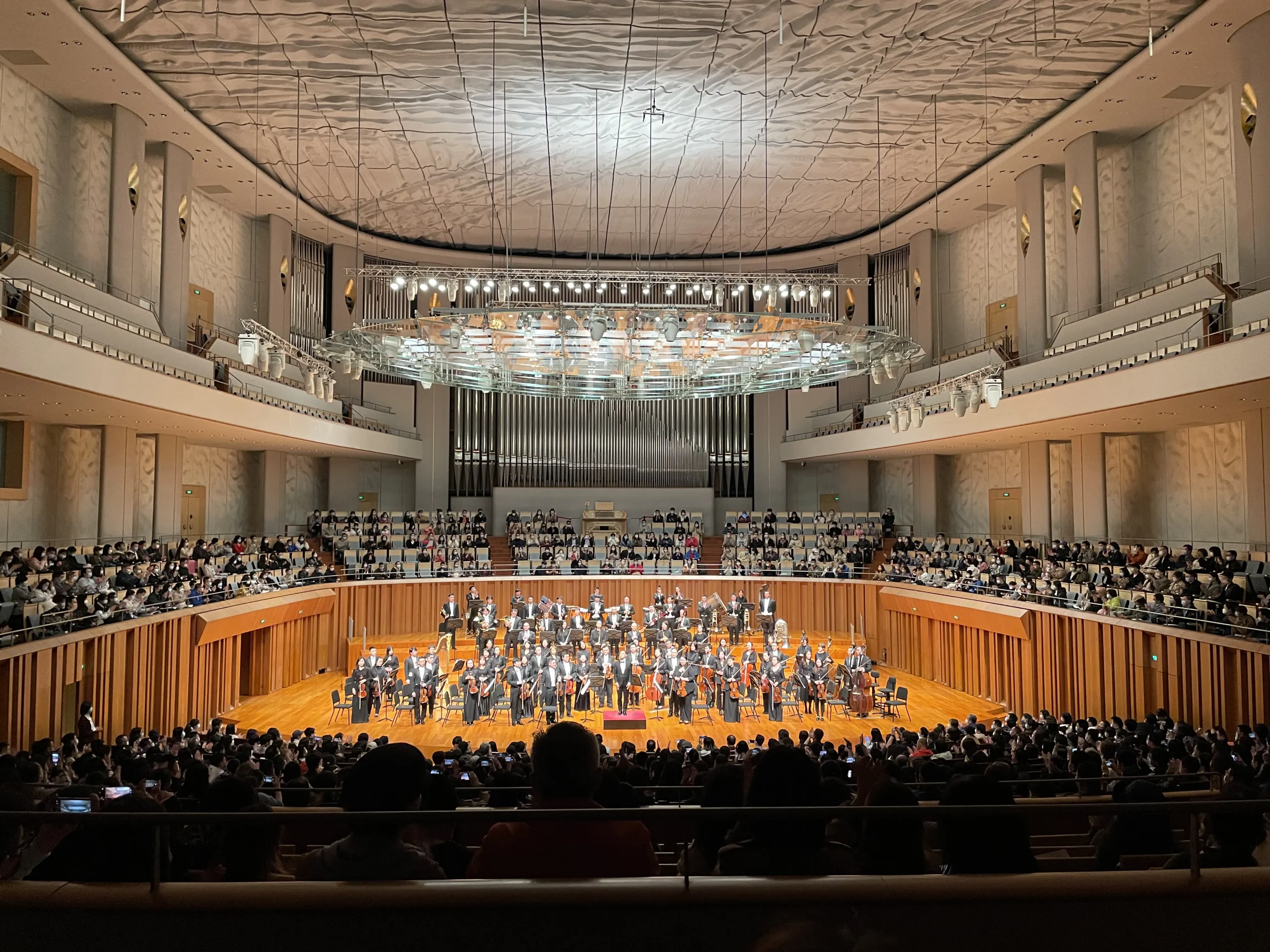
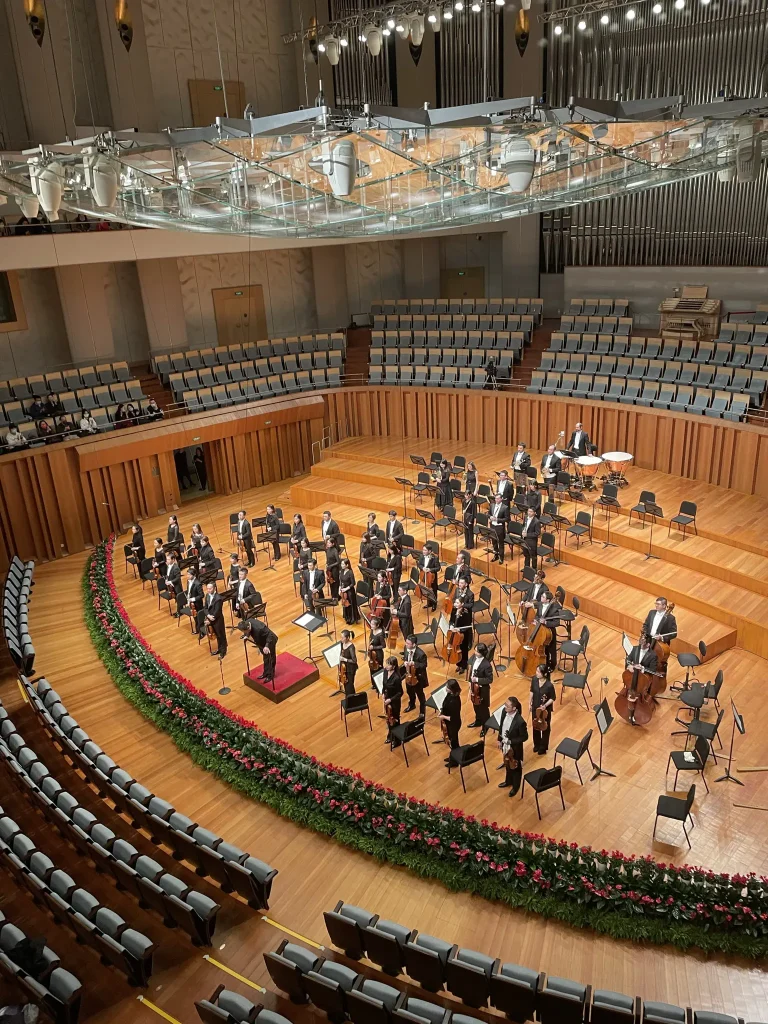
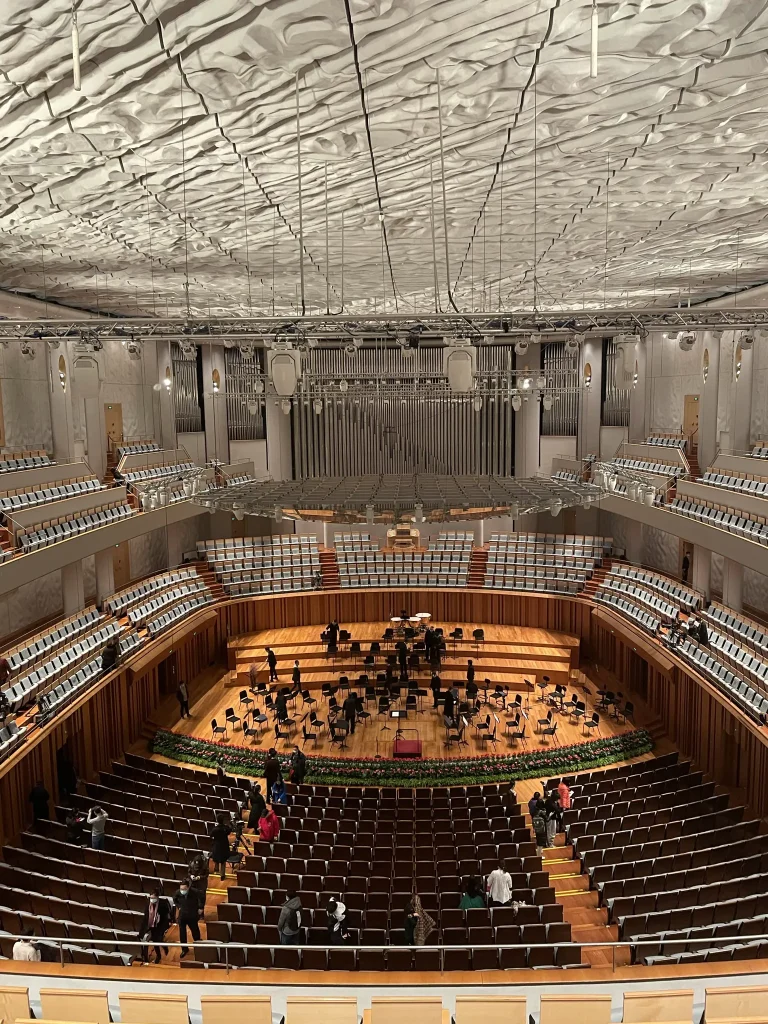
- The Concert Hall: This hall stands out for its clean silver-and-white colour scheme and seats almost 2,000 people. Its curved ceiling design evokes flowing sound waves and ensures exceptionally clear, natural acoustics. The focal point at the front is a monumental pipe organ with more than 6,500 pipes—one of the largest organs in Asia.
- The Theatre: Seating around 1,000 people, this hall is devoted mainly to theatre and traditional Chinese performances. Its walls are elegantly covered in real silk, giving the space an intimate feel with a strong connection to tradition.
Practical tips: Getting there, entering and security checks
Getting there: The quickest and easiest way to reach the concert hall is by Subway Line 1 to Tian’anmen West Station (天安门西站, Tiān’ānmén Xī Zhàn). Exit C leads through a direct underground passage straight into the foyer.
Entry and security checks: As with almost all sights around Tian’anmen Square, strict security measures apply at the concert hall. Make sure you allow plenty of time before the performance:
- ID requirements: For Chinese citizens, the ticket is linked to their ID number, which also serves as proof of admission. As a foreign tourist, you will usually book your ticket using your passport number. Because your passport cannot be scanned at the electronic gates, you first need to go to one of the ticket counters on either side of them. Show your passport there, and staff will enable you to pass through the electronic gates.
- Security check: After the ticket check, the security process is similar to the one at an airport. Small amounts of liquids are allowed, but you need to show them briefly during the check. Dangerous items of any kind, such as pocket knives, are not permitted.
- Tickets: You can buy tickets for performances through the official ticket platform (external link). Unfortunately, the official platform is available only in Chinese. If you don’t want to attend a performance but would still like to see the inside of the building, you can also book a daytime visit. The easiest way to book a sightseeing ticket is through Trip.com (affiliate link).
I recommend buying a ticket for a performance and arriving about 45 minutes early. That gives you enough time to pass through the entry checks without rushing and then explore the building’s fascinating architecture. It’s a wonderful opportunity to combine a traditional Chinese performance with some architectural sightseeing.
A little adventure along the way: I once found out for myself that these security measures are more than a formality. One evening, I wanted to go to a concert straight after work and naively thought taking a Didi (the Chinese equivalent of Uber) would be fastest. What I had completely forgotten was that an important political meeting was taking place that very evening in the neighbouring Great Hall of the People. The result was a nerve-racking journey: my driver encountered one police checkpoint after another, and the roads had already been closed to normal traffic. One by one, the other vehicles disappeared until we were literally among the last cars left on the streets. In the end, I made it into the Concert Hall by the skin of my teeth. So save yourself the stress and take the subway!
Between acoustics and culture shock: My personal impressions
The sound inside absolutely lives up to the promise of the building’s spectacular exterior. The acoustics in the Concert Hall really impressed me. I was equally overwhelmed by the stage design in the Opera House. I saw a performance of Madama Butterfly and was deeply impressed. The opera’s first act takes place in a Japanese garden, and they had even built an artificial river with boats on stage for it. It was a production on a scale I’ve rarely seen in Europe.
At the same time, a visit offers fascinating insights into the differences between theatre culture in China and Europe. In terms of musical quality, local orchestras often don’t quite reach the performance level of established top European orchestras. There is also a striking cultural difference in how the audience behaves. Chinese audiences are much more relaxed and, at times, almost seem uninterested. Many people use their smartphones during the performance to record short videos, take photos or type messages, so bright screens keep lighting up across the hall. The end of a performance feels very different, too: applause is usually brief and restrained. Almost as soon as the final note fades, people start heading out, and the seats empty in no time.
My verdict: A worthwhile stop for architecture and culture lovers
The National Centre for the Performing Arts is a fascinating concert hall with impressive architecture in Beijing. If you’re visiting Tian’anmen Square or the Forbidden City anyway, you should definitely make the short detour to the artificial lake—the futuristic dome is a spectacular photo opportunity even from the outside. You’ll find more places worth visiting in Beijing in my article on the Beijing’s best sights.
A look inside is especially worthwhile for two groups: architecture lovers who want to experience the unique sense of space and the walk beneath the lake, and anyone interested in culture who fancies a special evening at the theatre or opera. Whether you choose an elaborately staged Western classic or a traditional Chinese production, the monumental sets and the intriguing glimpses into local audience behaviour make the visit a worthwhile experience.
Have you ever visited Beijing’s “Giant Egg” or attended a concert somewhere else in Asia? What differences in audience behaviour have you noticed? Let me know in the comments below—I’d love to hear about your experiences!
1 thought on “Beijing’s Concert Hall: The National Centre for the Performing Arts”