Have you ever asked yourself while planning your trip to China: “Who was this Ming guy anyway, and why does everyone have his vases?” Don’t worry, you’re not alone! In Europe, we often think in centuries, but in China, people think in dynasties. They are the Chinese equivalent to eras like the Baroque, the Middle Ages, or the Renaissance in Europe. These periods are much more than just dusty history – they are the key to understanding modern-day China, its architecture, and even the self-image of its people. Let’s bring in this overview of China’s dynasties some order to the chaos together, so that during your next temple visit, you’ll know exactly what’s going on!
Why Dynasties? The Foundation of China
In China, rule was legitimized for millennia by the Mandate of Heaven (Tiānmìng 天命). As long as an imperial house ruled wisely and justly, it remained in power. If natural disasters or uprisings occurred, it was seen as a sign that Heaven had withdrawn the mandate and a new dynasty was allowed to take over.
This cyclical thinking shapes China to this day: history is not seen as a straight line, but as a constant state of flourishing and passing away. When you travel through China today, you will notice that people are extremely proud of this continuity. The dynasties are the roots that provide stability to modern China.
Time Travel: Overview on China’s Dynasties
In Chinese history, one empire follows another. To help you keep your bearings, I’ve put together the complete list of China’s dynasties as a quick overview. The dynasties marked in bold are those whose traces have particularly shaped China:
- Xia Dynasty (approx. 2100–1600 BC)
- Shang Dynasty (approx. 1600–1046 BC)
- Zhou Dynasty (1046–256 BC)
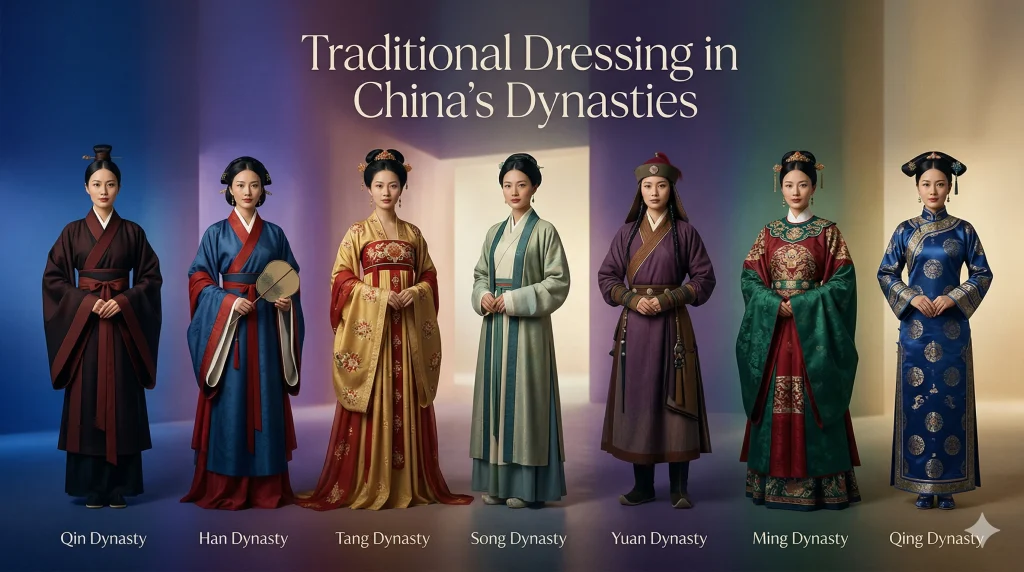
- Qin Dynasty (221–206 BC)
- Han Dynasty (206 BC – 220 AD)
- Three Kingdoms Period (220–280 AD)
- Jin Dynasty (265–420 AD)
- Northern and Southern Dynasties (420–589 AD)
- Sui Dynasty (581–618 AD)
- Tang Dynasty (618–907 AD)
- Five Dynasties and Ten Kingdoms (907–960 AD)
- Song Dynasty (960–1279 AD)
- Yuan Dynasty (1271–1368 AD)
- Ming Dynasty (1368–1644 AD)
- Qing Dynasty (1644–1912 AD)
The Most Important Dynasties and What You Need to Know
The Birth of the Empire: The Qin Dynasty (221–206 BC)
Although the Qin Dynasty lasted only 15 years, it was the actual “Big Bang” of China. Emperor Qin Shihuangdi was a radical visionary who united the fragmented country with an iron fist, laying the foundation for the name “China.” He abolished the old feudal system and introduced uniform measurements, currencies, and, above all, a standardized writing system – a legacy that ensures today that people across China can communicate in writing, even if they speak completely different dialects. When you stand before the monumental Terracotta Army (Bīngmǎyǒng 兵马俑) in the Mausoleum of Qin Shihuangdi in Xi’an today, you are looking directly into the face of this claim to power.
Identity and Cosmopolitanism: The Han Dynasty (206 BC – 220 AD)
Following the harshness of the Qin came the stability of the Han Dynasty, which laid the foundation of Chinese identity for over four centuries. The significance of this era of stability is shown by the fact that the ethnic majority of China is still referred to as Han Chinese (Hànzú 汉族). During this time, Confucianism was elevated to the state philosophy, anchoring education and respect for hierarchies deep within Chinese culture. However, the Han emperors also looked beyond their borders: they opened the legendary Silk Road (Sīchóu zhī lù 丝绸之路). Through these trade routes, not only precious silk reached the West, but Buddhism also arrived in China. An impressive testimony to this religious flourishing is the Longmen Grottoes (Lóngmén Shíkū longmen shiku) in Luoyang, where thousands of Buddha statues were carved into the rock.
The Golden Age: The Tang Dynasty (618–907 AD)
If the Han were the foundation, then the Tang Dynasty was the magnificent era of ancient China. The capital, Chang’an (modern-day Xi’an), was the New York of antiquity – a vibrant, tolerant metropolis where traders from all over the world converged. It was a time of poetry, art, and freedom, where women even played polo and Wu Zetian ascended the throne as the only officially recognized female emperor in China’s history. The modern role of tea as an everyday beverage also has its origins here, as it transformed during this era from a medicine into a social delicacy.
Innovation and Aesthetics: The Song Dynasty (960–1279 AD)
While Europe was still stuck in the depths of the mediaeval times , China experienced a technological renaissance under the Song Dynasty. The invention of the compass, gunpowder, and movable type printing made the country a global superpower. The economy boomed so much that the Song became the first government in the world to introduce official paper money. Yet, alongside technology, the culture flourished as well: fine ink wash painting of misty mountains and the perfection of porcelain art still shape our image of Chinese aesthetics today. Anyone wishing to feel the timeless beauty of this epoch should visit the West Lake (Xīhú 西湖) in Hangzhou. It was the center of countless Song poets and still looks like a painting come to life.
The Legacy of the Steppe: The Yuan Dynasty (1271–1368 AD)
The face of China changed radically with the Yuan Dynasty when Kublai Khan – grandson of Genghis Khan – conquered the country. For the first time, non-Han Chinese ruled the entire empire and made Beijing the capital. The Mongols brought a completely new dynamic and an efficient postal system with relay stations to the country. Since they distrusted the local scholars, they brought advisors from all over the world to the court, including the famous Marco Polo. When you stroll through the narrow, gray alleys of Beijing’s Hutongs (Hútòng 胡同) today, you are walking on a city layout designed by the Mongols over 700 years ago.
Splendor, Walls, and Vases: The Ming Dynasty (1368–1644 AD)
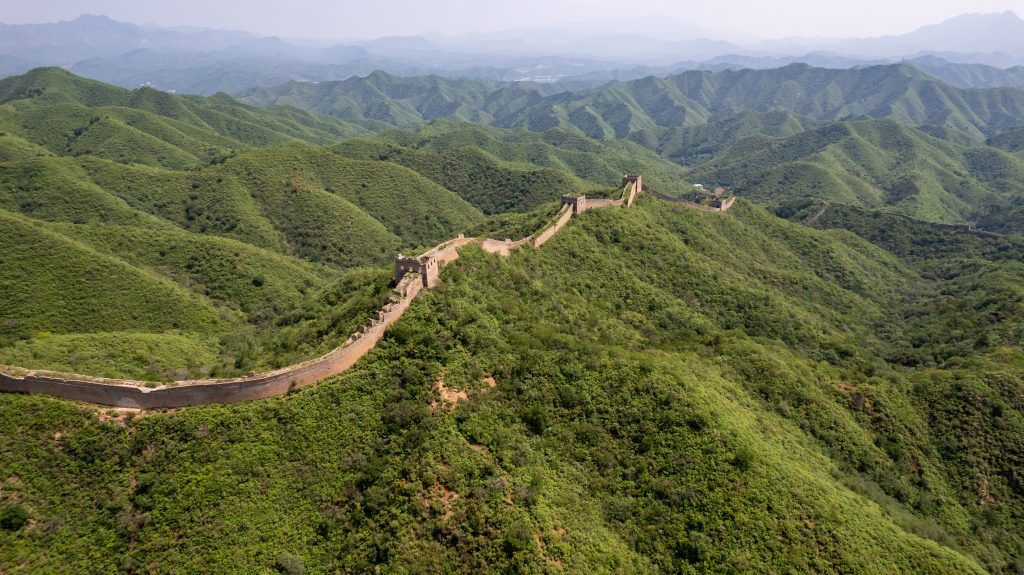
After the expulsion of the Mongols, the Ming Dynasty reflected on “true” Chinese values and monumental architecture. Almost everything we perceive today as “typically Chinese” dates back to this time. The Ming completed the Great Wall of China (Wànlǐ Chángchéng 万里长城) in its current stony splendor and created the mysterious Forbidden City (Gùgōng 故宫) in the center of Beijing. The Temple of Heaven (Tiāntán 天坛) in Beijing, with its perfect symmetry, also testifies to their urge for divine order. It was an era of splendor in which the famous blue-and-white Ming porcelain became a global luxury good and fueled the West’s longing for the Far East.

The Last Radiance: The Qing Dynasty (1644–1912 AD)
The conclusion of imperial history was formed by the Qing Dynasty, founded by the Manchus from the northeast. They expanded the territory to its current massive size and brought their own unique elegance – from the Peking Opera to magnificent gardens. However, the Qing era was also marked by tension and the forced wearing of the queue (braid) as a sign of submission for the Han population. While the empire eventually collapsed under the pressure of modernity, the Qing left us places of incredible beauty, such as the sprawling Summer Palace (Yíhéyuán 颐和园) in Beijing.
Understanding Yesterday, Traveling Today: My Conclusion
For me, diving into the Chinese dynasties is the ultimate door-opener. It makes a huge difference whether you just find a building “beautiful” or whether you understand the historical significance and context. This knowledge removes the distance and allows me to experience the culture much more intensively. By better understanding the Chinese dynasties, I have learned that the layout of Beijing is no coincidence, but the legacy of Mongolian horse lords of the Yuan Dynasty, and that the impressive Great Wall is the manifested desire for security of the Ming Dynasty. I hope this overview of China’s dynasties helps you better understand this historical context during your travels.
How about you? Have you ever gotten lost in dates during your travels, or was there that one moment when history suddenly came alive for you? I am incredibly excited to hear about your experiences in the comments!
10 thoughts on “China’s Dynasties – Your Compact Overview”