
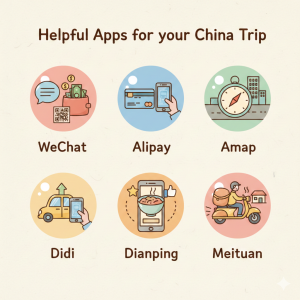
While we in Europe are familiar with apps like WhatsApp, Google Maps, and Uber, you will quickly notice on your trip to China that these providers either do not work at all or the data is outdated. The unimaginably extensive digitalization in China is both a blessing and a challenge at the same time. To ensure your holiday starts stress-free and you don’t get lost in the “app jungle,” I have put together an overview of the most important apps for your trip in China.
Paying in China: Nothing Works Without These Apps on Your Trip
The first thing you need to know about apps on your trip to China: in China, you don’t pay with cash or credit cards—you scan. The two major providers are WeChat (微信, Wēixìn) and Alipay (支付宝, Zhīfùbǎo).
WeChat is far more than just the Chinese WhatsApp. It is an entire ecosystem. Behind almost every QR code in a restaurant lies a so-called “Mini App.” Often, there are no printed menus at all. Instead, you scan the code at the table, order digitally, and pay directly within the app. Entrance tickets for sightseeing spots are also usually booked via these Mini Programs. So, keep your eyes open for QR codes at restaurants or sights during your trip and scan them with WeChat.
WeChat Download in the Apple App Store and Google Play Store
Alipay is the second major app ecosystem in China. It is your essential key to making payments. Be sure to set up Alipay before you depart! Verification with your passport and credit card can be a bit tricky, but it is unavoidable. It’s particularly practical that you can also pay for the subway via Alipay and access ride-hailing services without having to install countless individual apps.
Alipay Download in the Apple App Store and Google Play Store
Orientation and Transport: How to Find Your Way
Google Maps is unfortunately useless in China. For iPhone users, Apple Maps is the most helpful app alternative for your China trip. Since Apple accesses local data from Amap and reviews from Dianping, the maps are up-to-date and—best of all—completely usable in English and without a VPN.
If you don’t own an iPhone or need a solid Plan B, you should install Amap (高德地图, Gāodé Dìtú). Although the app is only available in Chinese, most places can be found using English search terms. Additionally, you can simply copy the Chinese names of the sightseeing spots from my blog into the app to ensure you reach the right location.
Amap Download in the Apple App Store and Google Play Store
When your feet get tired, Didi (滴滴出行, Dīdī Chūxíng) is your lifesaver. It is the Chinese equivalent of Uber. You simply enter your starting point and destination, see your driver’s license plate, and get picked up. Language skills are not necessary, as the driver already sees your destination in the app. Sometimes you only need to provide the last four digits of your phone number for identification when getting in. Payment happens automatically upon arrival once you have linked Didi to your Alipay account.
Didi Download in the Apple App Store and Google Play Store
The Best Apps for Restaurants and Food Delivery During Your China Trip
To find the best restaurants, Dianping (大众点评, Dàzhòng Diǎnpíng) is the ultimate database. Even though this app is also unfortunately only available in Chinese, the countless photos and star ratings are incredibly helpful. Another advantage: you can often book cheap set menus via Dianping. Due to the lack of translation, this sometimes turns into a real “blind box” surprise set, but it leads you directly to the restaurant’s most popular dishes. If you decide to buy one of these set menus in Dianping, you will receive a QR code after payment, which you can redeem on-site at the restaurant.
Dianping Download in the Google Play Store
If the weather is bad or you want to spend a cozy evening at the hotel, Meituan (美团, Měituán) is your friend. It is the “Uber Eats” of China. Delivery fees are vanishingly low, and the food is often with you within 30 minutes. Unfortunately, this app is also only in Chinese; luckily, however, pictures are displayed for most dishes to help you choose.
Overcoming the Language Barrier
Since many of the mentioned apps are only available in Chinese, Google Translate or Apple Translate are your rescue. Be sure to download the Chinese language pack for offline use in advance. Specifically, the Google Translate app will not work without a VPN during your trip to China. Many people in China do not speak English, and in the end, these apps are your final resort for communication. Furthermore, because many apps are only offered in Chinese, you will collect many screenshots and have them translated in your translation app.
My Personal Conclusion: Digitalization I Miss
When I think back to my own travels, I still remember that first moment of feeling overwhelmed. But as soon as you get the hang of Alipay and Didi, traveling in China feels incredibly smooth. Everything is interconnected and efficient.
To be honest, I sometimes miss this seamless digitalization when I’m back in Europe. China is digitally demanding, but if you embrace it, it makes your trip so much easier. Prepare well, download the apps in time, and then: Enjoy the journey!
Have you already had experiences with Chinese apps or are you currently planning your first trip? Let me know in the comments—I look forward to hearing from you!