

How many days do you need in Beijing? For your first visit, we recommend five full days, plus time for arrival and departure. This Beijing itinerary for your independent travel combines the Forbidden City, the Temple of Heaven and the Great Wall with walks through the hutongs and views of Guomao’s skyline.
Beijing feels like home to us. Hong studied and lived here, and I spent three years working in the city. We return regularly, partly because some of Hong’s family still live here. The combination of imperial history, narrow old-town lanes, modern city life and mountains on the doorstep still excites us and makes Beijing an ideal travel destination.
This itinerary brings together our picks for your first independent travel to Beijing. It works as a standalone city break and particularly well as a stop on a longer journey through China. For more ideas, you’ll find a wider selection in our overview of the best sights in Beijing.
Your Beijing Itinerary: 5 Days of Independent Travel at a Glance
| Module | Morning | Afternoon | Evening |
|---|---|---|---|
| 1: Imperial Beijing (closed on Mondays) | Tian’anmen Square and the Forbidden City | Jingshan Park and hutongs | Qianhai and Houhai |
| 2: Temples and Everyday Life (limited access on Mondays) | Qianmen and hutongs | Temple of Heaven, Lama Temple | Wudaoying Hutong |
| 3: Gardens and Landmark Architecture | Summer Palace | Summer Palace | Olympic Park |
| 4: Modern Beijing | 798 Art District | Liangma River and Sanlitun | Guomao skyline |
| 5: Great Wall | Travel to Mutianyu and ascent | Mutianyu | Return journey |
The numbered modules don’t have to be followed in a fixed order. Start by arranging your Forbidden City visit around ticket availability. Bear in mind that both the Forbidden City and parts of the Temple of Heaven are closed on Mondays.
I’ve also deliberately avoided packing too much into each day, giving you time to take in each place and explore the surrounding side streets. In Beijing, especially in the hutongs, spontaneous detours into nearby lanes often lead to interesting observations and experiences.
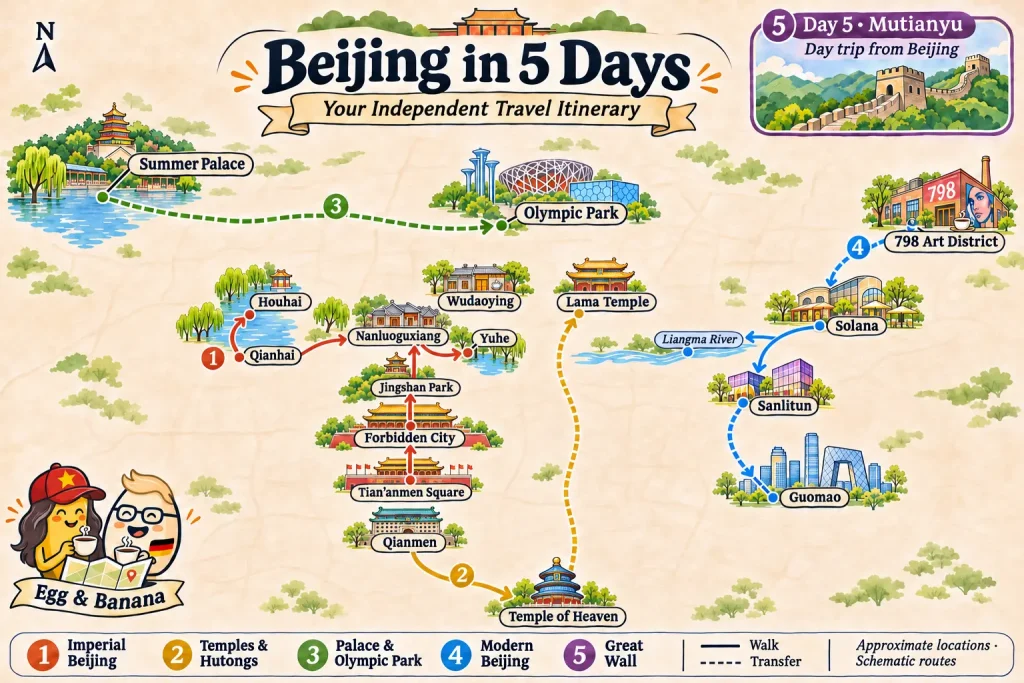
Module 1: The Forbidden City, Imperial Views and Hutongs
Start Your Morning at Tian’anmen Square
Begin at Tian’anmen Square (天安门广场, Tiān’ānmén Guǎngchǎng). Its vast open spaces and monumental buildings offer a first impression of Beijing as China’s political centre.

Entry is free, but an advance reservation is essential. You can book through WeChat or use the official Beijing city reservation website (external link). Unfortunately, both options are only available in Chinese. Allow time for the strict security checks and bring your passport.
If you’re interested in the morning flag-raising ceremony, you can start your day accordingly. It does mean a very early start, as the ceremony takes place at sunrise each day.
Time needed: approximately 60–90 minutes, including queues and security checks.
The Forbidden City: Palace of China’s Emperors
Next, head to the Forbidden City (故宫, Gùgōng). It lies directly opposite Tian’anmen Square, making the two easy to combine. Entry to the Palace Museum is through the southern Meridian Gate, known as Wumen.
What impresses me every time I visit is the sheer scale. You walk through gates and courtyards, only to discover more buildings beyond them. After a while, “palace” begins to feel like too small a word for the place.
Follow the central axis first, but leave time for selected areas on either side. Trying to see everything would take over the rest of your day. Three to four hours is a sensible starting point for a first visit.
To better understand the complex and its significance within the city, read our history of Beijing before you go.
Book in advance: Tickets are released seven days before your visit at 8 pm China time. Have your passport details ready and, if possible, book as soon as tickets become available through the official Palace Museum booking website (external link). Tickets purchased through the official channel cost CNY 60 in peak season, approximately EUR 8–9. As tickets can sell out within minutes of release, I particularly recommend booking through Trip.com (affiliate link). This option does, however, involve an additional booking fee.
Jingshan: See the Forbidden City from Above
After visiting the Forbidden City, leave through the northern Gate of Divine Prowess (神武门, Shénwǔmén). Jingshan Park (景山公园, Jǐngshān Gōngyuán) is directly opposite. For me, the climb to the viewpoint is an essential part of the visit. Tickets cost CNY 2, approximately EUR 0.30, and can be bought on arrival.
A moment ago, you were walking between the buildings. From above, you can see their layout, the rooftops and the clear axis running through the complex. This change of perspective really brings home the scale of the Forbidden City.
Time needed: around 60–90 minutes.
Through the Hutongs to the Water
The itinerary becomes deliberately more relaxed later in the afternoon. Head towards the hutongs around Nanluoguxiang (南锣鼓巷, Nánluógǔxiàng).
The famous main lane is only a small part of this neighbourhood. Our most important tip: turn into the side streets. We particularly like the area around the Yuhe (玉河, Yùhé). Search for 通惠河玉河遗址 in your map app to help you find it. There’s also a lovely café here if you fancy a break. Having coffee in the hutongs is among our fondest shared memories of Beijing. For us, these pauses are an integral part of travelling, especially after a morning of major sights.
The restored historic waterway lies between Nanluoguxiang and Shichahai, recalling Beijing’s connection to the old canal network. From here, make your way through the lanes and along accessible stretches of waterfront towards Qianhai (前海, Qiánhǎi). If you feel like walking further, continue to Houhai (后海, Hòuhǎi).
Time needed: approximately two hours, or longer with a café stop or an extended walk.
Alternative: If you’d rather visit another imperial garden, choose Beihai Park (北海公园, Běihǎi Gōngyuán) instead of the hutong walk. Trying to fit both in properly would make this day unnecessarily busy.
Module 2: Qianmen, the Temple of Heaven and the Lama Temple
This day brings together different sides of old Beijing. It has the tightest schedule of the city days in our itinerary, so start early and keep an eye on the Lama Temple’s last admission time.
Qianmen and the Lanes towards the Temple of Heaven
Start directly on Qianmen Street (前门大街, Qiánmén Dàjiē). The broad shopping street makes a striking introduction, but we often find the streets on either side more interesting. Take time to explore the small lanes before continuing towards the Temple of Heaven.
We particularly enjoy the unassuming residential neighbourhoods along this stretch. Monumental Beijing fades into the background, and you get a glimpse of everyday life between the major sights. Incidentally, the emperor once travelled this very route from the Forbidden City to the Temple of Heaven as part of the sacrificial rituals.
Time needed: around one and a half to two hours for Qianmen and the walk, including small detours.
Temple of Heaven: Architecture and Park Life
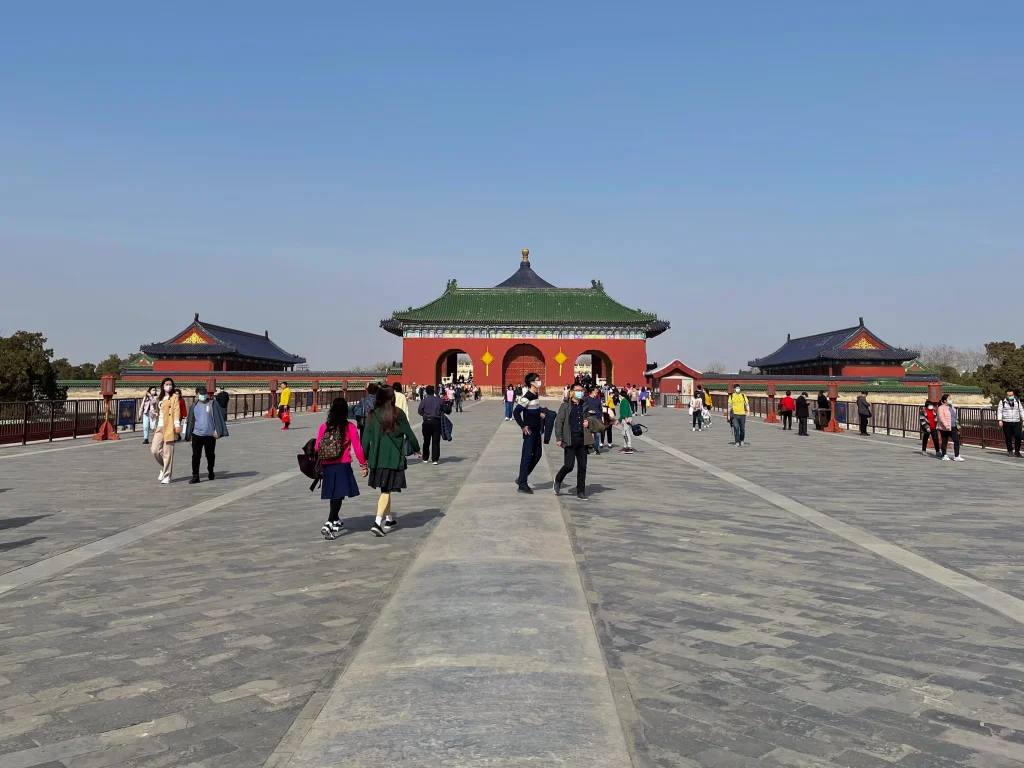
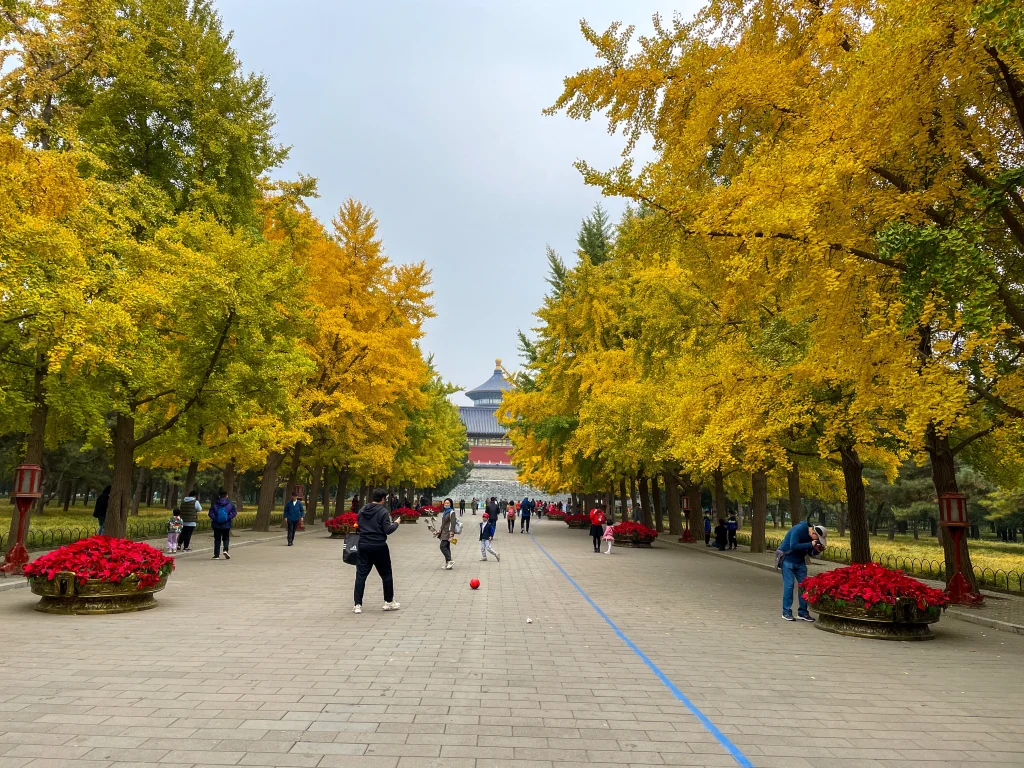
At the Temple of Heaven (天坛, Tiāntán), you’ll encounter another side of imperial rule. This was where emperors performed rituals and prayed for good harvests, making it a meaningful complement to your Forbidden City visit.
Alongside the famous buildings, allow some time for the park’s paths. We particularly like the park surrounding the Temple of Heaven and often came just for its extensive grounds when we lived in Beijing.
To visit the temple buildings as well, you’ll need the combined ticket, which you can buy directly at the park entrance. The Hall of Prayer for Good Harvests, Echo Wall and Circular Mound Altar are normally closed on Mondays, while the park remains open.
Time needed: around two to three hours.
You’ll find more detailed information in our separate article about the Temple of Heaven.
Take the Metro to the Lama Temple
If possible, leave through the East Gate for your onward journey. From Tiantandongmen, Line 5 takes you directly to Yonghegong without changing trains. Allow just under an hour for the journey, including walking and waiting time. The direct connection makes this transfer worthwhile despite the distance.
For us, the Lama Temple (雍和宫, Yōnghégōng) is one of the places you shouldn’t miss on your first visit to Beijing. Its palace-like architecture has a historical explanation: the complex was originally an imperial residence before becoming a Tibetan Buddhist monastery.
Time needed: around one to one and a half hours.
Keep a close eye on the time: last admission is normally at 4 pm from November to March and 4:30 pm from April to October. Leave enough time to explore before closing.
Wind Down in Wudaoying Hutong
Nearby is Wudaoying Hutong (五道营胡同, Wǔdàoyíng Hútòng). The lane runs west from Yonghegong Street towards Andingmen.
We find this neighbourhood particularly appealing. After the scheduled sightseeing, it’s worth slowing down, having a coffee and exploring the neighbouring lanes too.
If the day gets too busy: Cut back on the extra morning detours first. If you start later or want to spend longer at the Temple of Heaven, move the Lama Temple to another day. Opening hours shouldn’t turn your visit into a race.
Module 3: The Summer Palace and Olympic Park
Give the Summer Palace Plenty of Time
Today, our itinerary takes us to the Summer Palace (颐和园, Yíhéyuán) in northwestern Beijing. One way to structure your visit is to start at the East Gate, explore the main buildings, continue along the Long Corridor and then take a walk beside Kunming Lake.
You can buy your Summer Palace ticket directly at the East Gate. Allow approximately 60 minutes to get here from the city centre, including changes and walking time. Certain visitor areas remain closed on Mondays.
Time needed: around three to four hours.
Olympic Park in the Afternoon
After the Summer Palace, I recommend taking the metro to Olympic Park, home to the Bird’s Nest and the Water Cube.
For our Beijing travel itinerary, an independent walk around the distinctive buildings is enough. I’d only recommend adding an interior visit if you have a particular interest. The extensive Olympic Forest Park stretches north of the sports venues. Again, I wouldn’t recommend trying to explore the entire park as part of a Beijing sightseeing itinerary.
Module 4: Art, Riverside Walks and Skyline Views
A Morning in the 798 Art District
Start your day in the 798 Art District (798艺术区, 798 Yìshùqū). Among the former industrial buildings, you’ll find exhibitions, galleries, shops and cafés.
We enjoy spending time here without a tight schedule. Stopping at a café in 798 is as much a part of the visit for us as exploring the streets and small art shops. These quiet breaks offer a welcome counterbalance to the excitement of the city.
Time needed: around two to three hours. If you want to visit a major exhibition, allow longer and shorten your afternoon plans.
From Solana along the Liangma River to Sanlitun
After visiting 798, head to Solana shopping centre. It’s one of our favourite malls in Beijing: the open layout and numerous walking paths invite you to take a leisurely stroll through the grounds, even if you don’t intend to buy anything.
From here, your walk follows the Liangma River (亮马河, Liàngmǎ Hé). This part of Beijing has changed considerably in recent years and has become a popular neighbourhood with trendy shops and cafés. Follow the riverside promenade first, then continue through the embassy district towards Sanlitun. It’s an easy way to combine a break by the water with the walk to your next neighbourhood.
Allow approximately two to three hours for Solana shopping centre and the riverside walk towards Sanlitun.
Sanlitun: Another Side of the City
In Sanlitun (三里屯, Sānlǐtún) and around Taikoo Li, Beijing shows its international, shopping-loving, fashion-conscious side. Even if you’re not planning to buy anything, it’s worth taking a stroll. To us, neighbourhoods like this are as much a part of the city as its historic sights.
We find Beijing’s nightlife less prominent than in other major Chinese cities. Even so, Sanlitun is a place where you’ll find restaurants, bars and options for a night out.
Time needed: around one to one and a half hours.
Guomao: Our Evening among the Skyscrapers
Finish the day in Guomao (国贸, Guómào). If you still have energy, you can walk from Sanlitun to Guomao in approximately one and a half hours. Otherwise, take Metro Line 10 from Agricultural Exhibition Center station (农业展览馆站) to Guomao station (国贸站).
We lived nearby and really appreciated the location in our everyday lives: good transport connections, plenty of restaurants and the convenience of getting things done close to home. That’s another reason why this part of Beijing holds so many memories for us.
Our favourite skyline viewpoint is the terrace at China World Mall. From here, you can see the distinctive CCTV building among the surrounding towers.
You’ll find more ideas for Guomao, Sanlitun and the shopping centres in our Beijing Shopping Guide.
Module 5: A Day on the Great Wall at Mutianyu
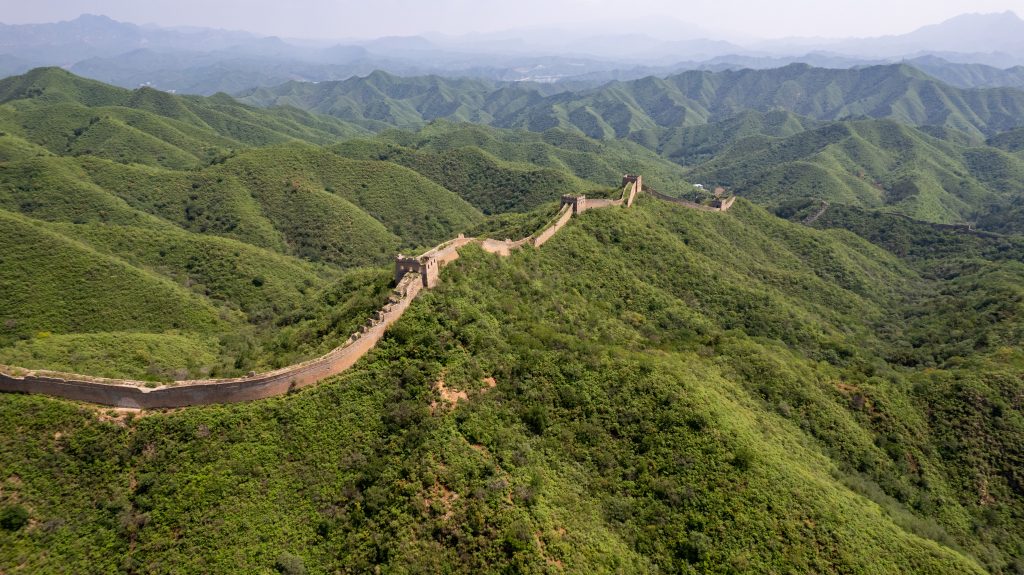
For us, the Great Wall is an essential part of any independent Beijing travel itinerary. We love hiking, and the combination of sightseeing and mountain scenery never loses its appeal.
Why Choose Mutianyu for Your First Visit?
For this itinerary, we’ve chosen Mutianyu (慕田峪, Mùtiányù) as an introduction. It keeps the logistics manageable while giving you a full day to enjoy the wall and its surroundings.
Excursion buses leave from several locations in central Beijing. You can find initial information about these services on the official Mutianyu Great Wall website (external link). As departure times can change with the season, I strongly recommend checking the exact bus services with your hotel. Alternatively, you can arrange a driver for the return trip.
As a rough planning guide, allow:
- Around two hours each way for the journey, or longer depending on your departure point and traffic.
- Three to four hours on the wall, depending on your route and fitness.
Check what’s included when buying tickets. Admission, the shuttle and the cable car are separate components. You can buy tickets at the ticket machines on site.
Remember to bring water, a snack and suitable shoes. You can also buy extra water from drinks vending machines on site. Hiking boots aren’t necessary, but I recommend comfortable, supportive trainers.
Hiking Alternatives: Panlongshan and Jinshanling
If you enjoy hiking and don’t mind putting more effort into getting there, consider Panlongshan (蟠龙山, Pánlóngshān) or Jinshanling (金山岭, Jīnshānlǐng).
Panlongshan is one of our personal favourites. The less-restored stretches of the wall and the surrounding landscape have a special appeal. You’ll find our experiences and advice in our article about the Great Wall at Panlongshan.
These less-developed sections of the wall do require more preparation, however. In particular, there is no public transport to these sections, so you’ll need a private driver for the day.


Practical Tips for Your Independent Trip to Beijing
Where to Stay? We Recommend Guomao
For an independent trip following our Beijing itinerary, we recommend staying around Guomao on the eastern Third Ring Road, ideally within a short walk of a metro station.
Guomao has several metro stations, and numerous lines serve the modern business district. Together with its many restaurants and shopping centres, this made it a very practical base for us.
Our value-for-money recommendation is the Beijing Guoan Hotel (affiliate link). We’ve enjoyed staying here on our trips to Beijing thanks to its convenient location right by Dongdaqiao metro station, reasonable prices and practically designed rooms.
If you prefer something more luxurious, Hotel Jen by Shangri-La (affiliate link) is our top choice in Beijing. The hotel is right in the heart of Guomao, with attractively designed rooms offering impressive views of Beijing’s skyline.
Which Reservations Should You Prioritise?
| Place | Important for Your Beijing Itinerary |
|---|---|
| Forbidden City | Advance booking is essential; tickets are released seven days ahead at 8 pm China time; closed on Mondays |
| Tian’anmen Square | Advance reservation is essential; in our experience, reservations are still available a few days before visiting |
| Temple of Heaven | Tickets can be bought on arrival; choose the combined park and temple ticket; partially closed on Mondays |
| Summer Palace | Tickets can be bought on arrival; partially closed on Mondays |
| Mutianyu | Arrange and book your transfer in advance; tickets can be bought on arrival |
When Is the Best Time for an Independent Travel to Beijing?
My favourite season in Beijing is autumn, especially mid- to late October, after the National Day holiday week. I particularly enjoy this time of year for long walks and excursions.
Spring, from late March to early May, is another option. Expect heat in summer and very cold weather in winter.
More Time in Beijing? Add These Modules to Your Independent Travel Itinerary
Another Day on the Great Wall
For us, a second visit to the wall is well worth considering. The sections differ in scenery, condition and atmosphere.
If you visit Mutianyu first, you can then plan a more hiking-focused day at Panlongshan or Jinshanling.
A Day Trip to Tianjin
Tianjin offers a different perspective on Chinese urban history and makes a good addition to a Beijing trip. With just one day, I’d focus on the city centre and walks along the Haihe River.
Our article on the best sights in Tianjin will help you plan your day trip.
A Day at Universal Studios Beijing
If you enjoy theme parks, you can add a full day at Universal Studios Beijing. Opened in 2021, the park brings together seven themed lands, from Harry Potter and Jurassic World to Transformers and Kung Fu Panda.
We particularly enjoyed the Harry Potter themed land. Between Hogsmeade’s snow-covered rooftops and Hogwarts Castle, you can immerse yourself in the world of the films.
Universal Studios is open daily. Tickets can be purchased through WeChat and the official Universal Studios app. You’ll find an overview of the different sales channels on the Universal Studios Beijing website (external link).
Our Verdict: Five Days to Get to Know Beijing
We love Beijing because it brings together so many sides of China. In five full days, you can visit the major historic sights, explore modern neighbourhoods and spend a day on the Great Wall.
Our itinerary gives your independent travel to Beijing a structure. But the moments we remember most from our walks often happen in between: turning into a small lane, stopping at a café or spontaneously lingering somewhere a little longer.
Book the important tickets and plan your transport in advance, then leave yourself enough flexibility to explore each day.
Which side of Beijing appeals to you most: the imperial centre, the hutongs, the modern city or the Great Wall? Let us know in the comments.
Experience behind this itinerary: years spent living in Beijing and repeat visits, including in 2026; most recent independent trip in November 2026. Visitor information last researched: 9 November 2026.
1 thought on “Beijing in 5 Days: Your Independent Travel Itinerary”