

I lived in Beijing for three years. The city became a second home to me — and a place full of history and culture that I still want to learn more about. That’s exactly why it’s worth taking a closer look at the history of Beijing before your travel. Behind the red palace walls, temples and narrow lanes are connections that make a visit truly interesting.
You don’t need to memorise an endless list of emperors. It’s more useful to understand the major changes: the rise of a city on the northern edge of Chinese empires, its development into the Mongol capital, the monumental Beijing of the Ming and Qing dynasties, and finally its transformation into today’s metropolis.
Beijing wasn’t always China’s capital. Several times, the city gained this status, lost it again and returned to the political centre under new rulers. Different dynasties shaped both the cityscape and the lives of its residents. You can still discover this eventful history on your travel to Beijing today.
The History of Beijing: A City Between China’s Heartland and the North
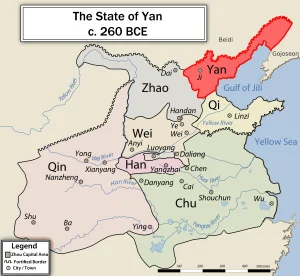

Beijing was by no means always the capital of China. While other cities, such as Chang’an, now Xi’an, or Luoyang, served at times as the political centres of great empires, the Beijing area lay along their northern frontier for a long time.
The city’s origins go back around 3,000 years. The early city of Ji (蓟, Jì), which later served as the capital of the State of Yan, played an important role. It lay southwest of today’s city centre. So if you’re looking for Beijing’s beginnings, you first need to shift your attention away from the Forbidden City: the earliest urban settlement and the later imperial palaces were not in the same place.
This location made the city strategically important. Here, routes across the North China Plain met the approaches to the mountains and steppe regions to the north. Beijing developed in a meeting zone where people traded, negotiated and repeatedly fought.
When Beijing Was Still Called the “Southern Capital”
An initially confusing chapter begins under the Liao dynasty. From 938, the city was one of its several capitals, known as Nanjing, or “Southern Capital”. This really does mean Beijing, not today’s city of Nanjing on the Yangtze. From the perspective of an empire whose centres lay much farther north, the name made perfect sense.
In 1153, the Jurchen rulers of the Jin dynasty made the city their main capital, Zhongdu (中都, Zhōngdū), the “Central Capital”. One visible reminder of these early periods is the Tianning Temple Pagoda (天宁寺塔, Tiānníng Sì Tǎ). It dates from the late Liao period, around 1120, making it considerably older than the present imperial palace. If you’re particularly interested in architecture, this is a connection to the history of Beijing that’s easily overlooked on the usual travel routes.
The Mongol Conquest: Beijing Becomes the Capital of a Great Empire
In 1215, the Mongols captured Zhongdu, leaving the city severely damaged. Under Kublai Khan, a new capital later emerged northeast of the former centre: Dadu (大都, Dàdū), the “Great Capital”. With the Yuan dynasty and the conquest of the Southern Song in 1279, all of China was ruled from here for the first time.
Beijing’s North–South Axis: A Centuries-Old Idea Shapes the City
Beijing’s central north–south axis has its origins in this planned city of the Yuan dynasty. The Ming and Qing emperors developed it further, adding palaces, gates and ritual sites. Since 2024, the ensemble of the Beijing Central Axis has been a UNESCO World Heritage Site (external link).
During my three years in Beijing, I always found this layout particularly interesting. In the centre, the arrangement of the major buildings feels logical and easy to follow. What surprised me was just how old this idea is. The layout that still helps you find your bearings today has its roots in a capital planned centuries ago. That doesn’t mean the city remained unchanged. What fascinates me is precisely how this organising principle survived so many changes.
Why the Old Town’s Lakes Are More Than a Backdrop
A capital with an imperial court, administrators and soldiers needed reliable supplies. The Grand Canal connected the political centres in the north with important economic and agricultural regions farther south. Grain and other goods could be transported over long distances along this network of waterways.
So when you walk around Shichahai (什刹海, Shíchàhǎi) on your travel to Beijing, it’s worth looking into its history. The lakes were part of the infrastructure that made life in the capital possible in the first place. This is also where Beijing’s history connects with the history of Suzhou: the Grand Canal linked cities with very different roles within the same empire.
The Ming Dynasty: Imperial Beijing Takes Shape
After Yuan rule ended in 1368, the political centre of the new Ming dynasty was initially in Nanjing, and Beijing lost its status as the capital. It was Emperor Yongle who moved it north again. In 1403, the city first received its present name, Beijing (北京, Běijīng) — “Northern Capital”. In 1421, Beijing became the empire’s principal capital.
This period laid the foundations for many of the sights that shape a travel to Beijing today. Have I overwhelmed you with the history of all these dynasties already? You’ll find some help in my overview of China’s dynasties for your trip.
The Forbidden City and the Temple of Heaven: How the Emperors Ruled and Worshipped Heaven
Between 1406 and 1420, Emperor Yongle had the Forbidden City built. Today, it is also known as Gugong (故宫, Gùgōng), the “Old Palace”. It became the seat of government and residence of the Ming emperors and, later, the Qing emperors. Access was strictly controlled — so the name “Forbidden City” is no coincidence.
Its size surprised me during my visits. To me, “palace” suggests one large building. Here, though, you’re standing before an entire city within a city: covering around 72 hectares, the complex stretches almost a kilometre from north to south.
What particularly fascinates me is how the clear north–south arrangement of central Beijing continues within the Forbidden City. Here too, a central line runs through the most important gates, courtyards and halls. On a smaller scale, you encounter the same organising principle as in the city around it.
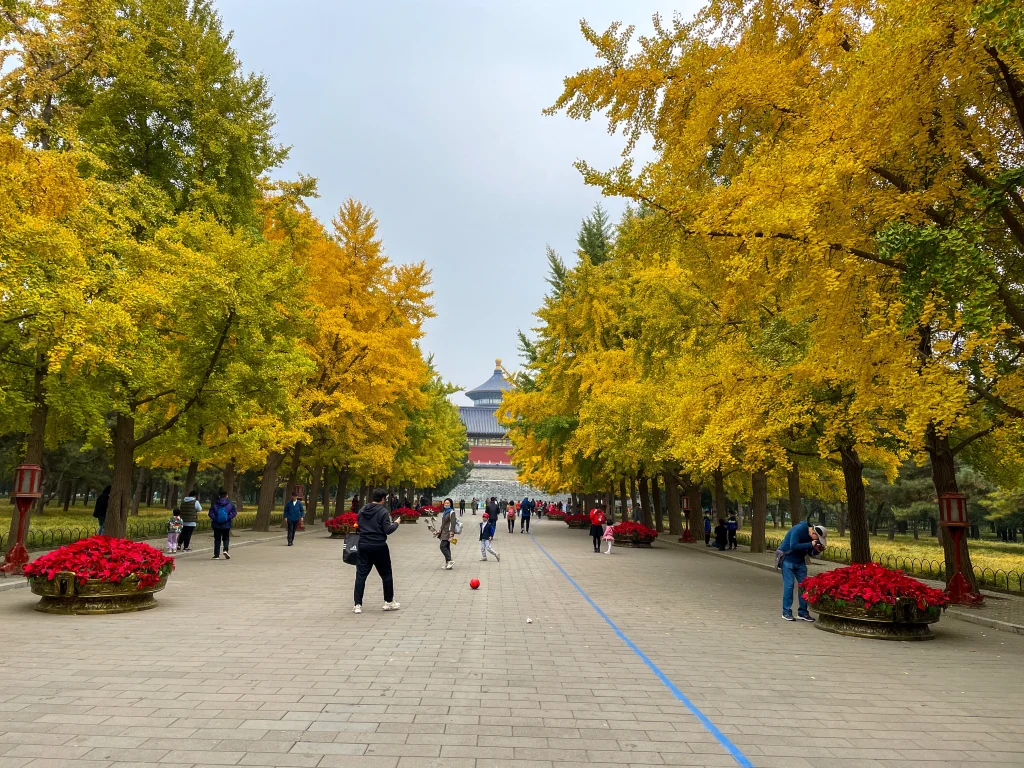
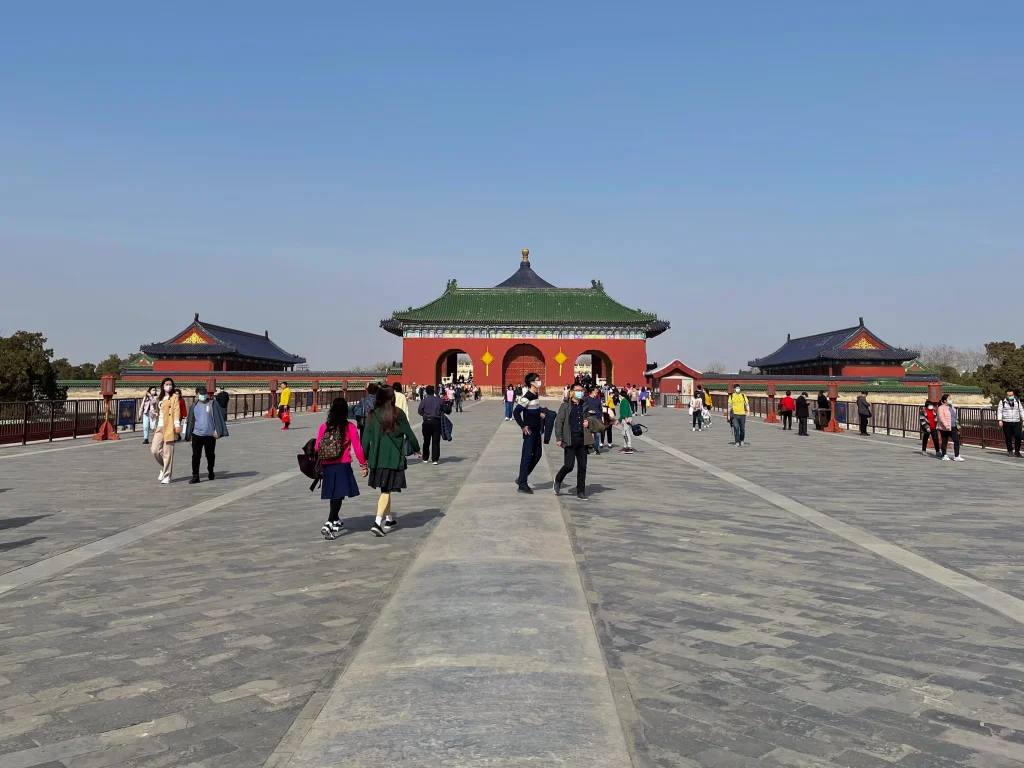
The original complex of today’s Temple of Heaven (天坛, Tiāntán) was also completed in 1420. Here, the emperors performed sacrificial ceremonies and prayed for good harvests. Behind this lay an understanding of rulership that connected politics, agriculture and the cosmic order. The emperor was regarded as the “Son of Heaven” and acted as an intermediary between Heaven and humanity during the rituals.
The Great Wall: The Capital and Its Northern Frontier
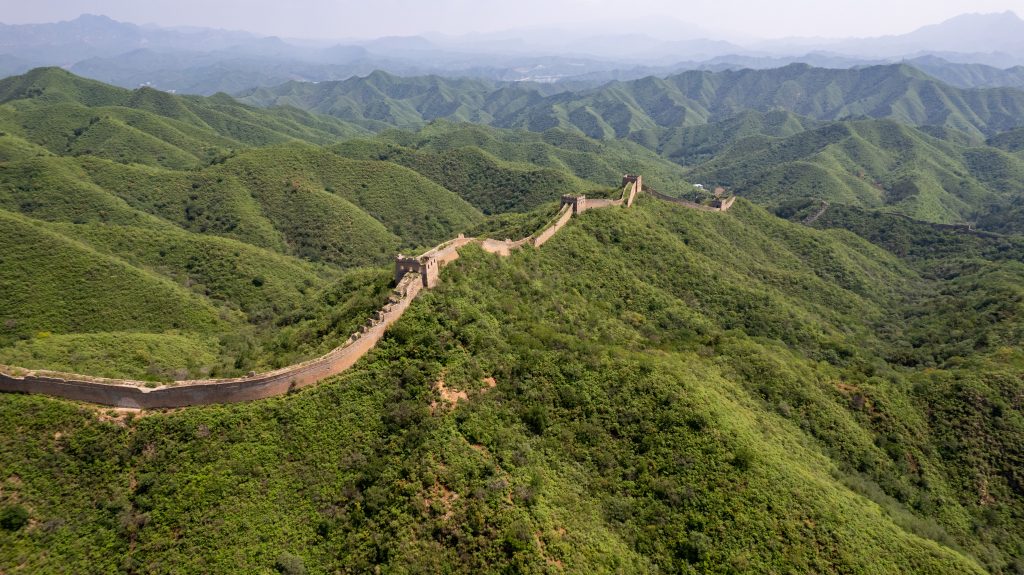
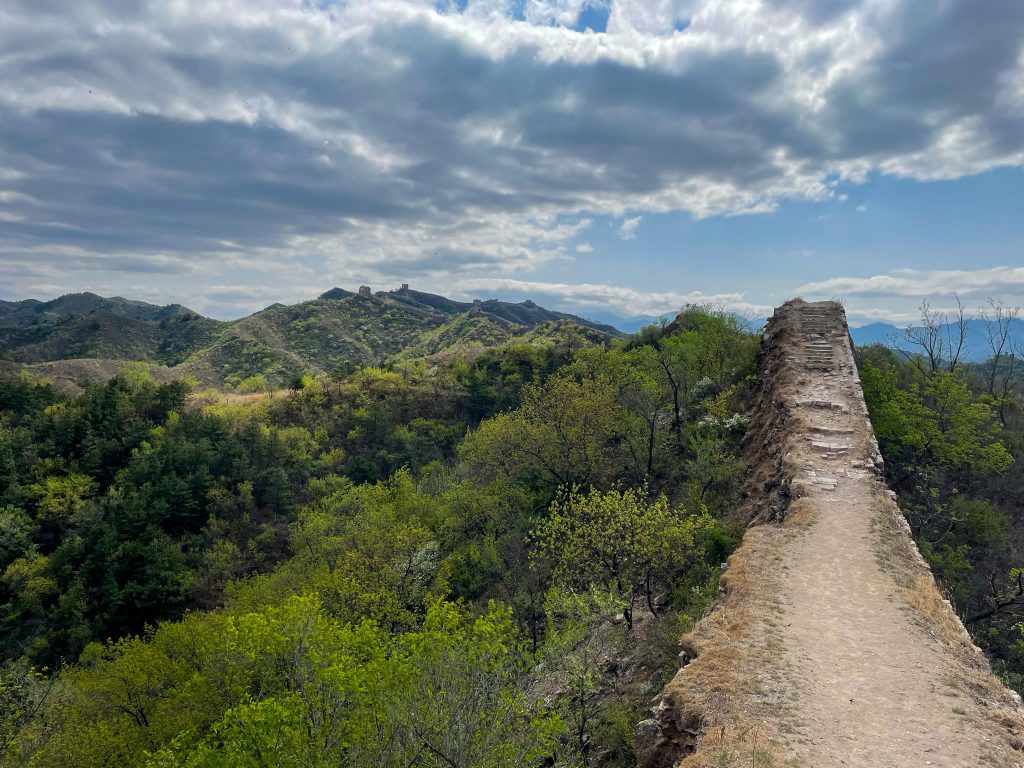
The Great Wall (长城, Chángchéng) also belongs in this context. It isn’t a structure that a single emperor had built in one continuous undertaking. Different states and dynasties built fortifications over long periods, extending, abandoning or replacing them. The familiar sections around Beijing are mainly associated with the Ming period.
I introduce one of these sections in more detail in my article about the Great Wall at Panlongshan.

1644 and the Qing Dynasty: New Rulers in the Old Capital
Jingshan: A View of the Palace and the End of a Reign
In 1644, rebels led by Li Zicheng captured Beijing. Chongzhen, the last Ming emperor to rule from Beijing, took his own life on Jingshan (景山, Jǐngshān), north of the Forbidden City. This makes the site directly connected to the end of Ming rule in the capital.
For me, Jingshan is one of the best places to see the Forbidden City as a whole. Inside the complex, you walk from one courtyard to the next. From above, you can take in its full extent: the sea of roofs, the large open spaces and the clear axis running through the palace.
Knowing how Chongzhen’s life ended gives this view a tragic quality for me. I can’t help imagining how he might have looked out over his palace and the surrounding city one last time. That’s precisely why, for me, Jingshan belongs alongside a visit to the Forbidden City. The view from above helps you understand its architecture — and also reminds you how vulnerable even a seemingly unshakeable rule could be.
Later that same year, the Manchus took control of Beijing. Their Qing dynasty retained the city as the capital and continued to use the existing palaces. For travellers, this is an important point: Ming and Qing are not neatly separated layers in the cityscape. Many complexes were founded by one dynasty and altered or extended by the other.
The Lama Temple and the Summer Palace Under the Qing
The Yonghe Temple (雍和宫, Yōnghégōng), usually called the Lama Temple, tells this story in a particular way. The complex was originally the residence of the future Yongzheng Emperor. In 1744, under his successor Qianlong, it was converted into a Tibetan Buddhist monastery.
This background helps explain why the complex feels so distinctly palatial. On your travel to Beijing, you’re walking through a place whose function changed while its architecture preserved part of its history.
Under Qianlong, work also began in 1750 on the extensive gardens from which today’s Summer Palace (颐和园, Yíhéyuán) developed. Lake, hills, halls, bridges and covered walkways were brought together in a carefully composed landscape. The complex was severely damaged in 1860 and later rebuilt.
From Empire to Republic: Beijing Loses Its Emperor and Its Capital Status
The end of imperial rule followed a long crisis. Military defeats, foreign influence and growing discontent had weakened the Qing dynasty. Its late attempts at reform could no longer halt the loss of confidence. When an uprising broke out in Wuchang in October 1911, numerous provinces broke away from the imperial government. In early 1912, a rival republican government formed in Nanjing under Sun Yat-sen.
The influential military leader Yuan Shikai played a key role. He was promised the presidency in exchange for military support for a republic. Under this political and military pressure, the imperial court announced the abdication of the young Emperor Puyi in February 1912. Puyi was initially allowed to continue living in the inner palace and did not have to leave until 1924. In October 1925, the imperial residential quarters opened to the public for the first time as part of the newly established Palace Museum.
Why the Capital Moved to Nanjing
The emperor’s abdication did not immediately end Beijing’s role as the capital. Yuan Shikai governed the republic from here. After his death in 1916, however, a succession of military leaders struggled for control of the government.
The decisive change came with the Kuomintang’s Northern Expedition under Chiang Kai-shek. Following the defeat of the northern rulers in 1928, the new Nationalist government consolidated its power and established Nanjing as the capital. The move primarily reflected a shift in political power: the new seat of government was in the south, where the victorious forces were based. Beijing was renamed Beiping (北平, Běipíng), roughly “Northern Peace” — the reference to its status as a capital disappeared from its name.
This had direct consequences for the city’s residents. As government offices and related households moved away, jobs and customers disappeared. Shops, restaurants and craft businesses suffered from the economic downturn. The former capital had to find a new role, with its historic buildings, educational institutions and the promotion of tourism becoming increasingly important.
These years therefore changed Beijing in contradictory ways. The city lost political power and economic security while its palaces and gardens opened to a wider public. The Beijing you can explore today, with its museums, historic parks and imperial sights, was significantly shaped by this transitional period.
Beijing at War: Japanese Expansion and Eight Years of Occupation
During the 1930s, Beijing increasingly found itself at the centre of a conflict whose causes reached far beyond the city. Japan had occupied Manchuria in northeastern China in 1931 and subsequently expanded its military and political influence into northern China. As a result, Beijing, then known as Beiping, came under growing pressure.
Although the city was no longer China’s capital, it remained an important centre of education and culture. At the same time, the Beijing–Tianjin region and its railway connections were of considerable strategic importance. Whoever controlled these transport routes could move troops and supplies and expand their influence across northern China. By the summer of 1937, Chinese and Japanese units faced each other in Beijing’s immediate surroundings.
On 7 July 1937, an armed clash broke out during a Japanese night-time military exercise near the Lugou Bridge (卢沟桥, Lúgōu Qiáo) and the fortified town of Wanping. Local negotiations failed to bring a lasting end to the fighting, additional troops were brought in, and Japan expanded its attacks. By late July, Beijing and Tianjin had come under Japanese control. In August, the fighting spread to Shanghai. The regional confrontation developed into a full-scale war that lasted until 1945.
For Beijing, this marked the beginning of eight years of occupation. The city became an administrative centre for the Japanese-occupied territories of northern China. A Chinese government dependent on Japan, established in December 1937, was based here. Beijing’s role changed fundamentally: the former capital now served to organise and maintain the occupation.
The disruption is particularly clear in the history of its universities. Peking University and Tsinghua University moved their teaching activities first to Changsha and later to Kunming. Beijing consequently lost many of the academics and students who had shaped its intellectual life. The occupation of Beijing ended only with Japan’s defeat in 1945.
If you’d like to explore this part of history more closely on your travel to Beijing, Wanping, the neighbouring Marco Polo Bridge and the Museum of the War Against Japan provide a local connection. Here, you can understand how closely Beijing’s history is tied to the expansion of a war that eventually impacted large parts of China and East Asia.
Beijing Since 1949: A Capital Changes Its Face
Beijing Becomes the Capital Again: From Civil War to the People’s Republic
The end of the Japanese occupation in 1945 did not bring lasting peace to China. The conflict between the Nationalist Kuomintang government and the Communist Party developed once again into a full-scale civil war. By early 1949, communist troops had gained the upper hand in northern China and surrounded Beijing, then still called Beiping. At the end of January 1949, power changed hands without an assault on the historic city centre. The population and the many historic buildings were therefore spared a major battle within the city.
Beijing now became the centre of preparations for the new state. The communist leadership moved here in March. Its selection as the future capital reflected the distribution of power at the time, as northern China formed an important political and military base for the new leadership. On 27 September 1949, Beiping was officially designated the capital and renamed Beijing. On 1 October 1949, Mao Zedong proclaimed the founding of the People’s Republic of China from Tian’anmen Gate.
This marked the beginning of profound changes to life in Beijing. The city was to become both a seat of government and an industrial centre. This transformation became particularly visible at Tian’anmen Square (天安门广场, Tiān’ānmén Guǎngchǎng). Over the following decades, it acquired key elements of its present monumental design. The historic gate and the imperial city consequently stand directly alongside the grand public buildings of the modern capital.
I find this contrast particularly interesting. On one side lies the expansive, ceremonial square of the People’s Republic. On the other, beyond Tian’anmen Gate, the route towards the Forbidden City begins, with its dense succession of gates, walls, courtyards and halls.
Both spaces feel monumental to me, but in different ways. The square creates its effect through openness and breadth, while the Forbidden City does so through the sequence of its spaces and the carefully graded sense of proximity and distance. Their immediate proximity makes the changing forms of rule in the history of China and Beijing particularly tangible.
From Industrial Heritage to Skyline: 798 and the New Business Centre of Guomao
You’ll find a very different chapter in the 798 Art District (798艺术区, 798 Yìshùqū). The former electronics factories were built in the 1950s with support from Soviet and East German specialists. Today, the UCCA Center for Contemporary Art is among those using the former factory buildings. Large halls, tall windows and industrial structures tell of a period when the city gained new production facilities. Their present use shows how industrial heritage can become a place for contemporary culture.
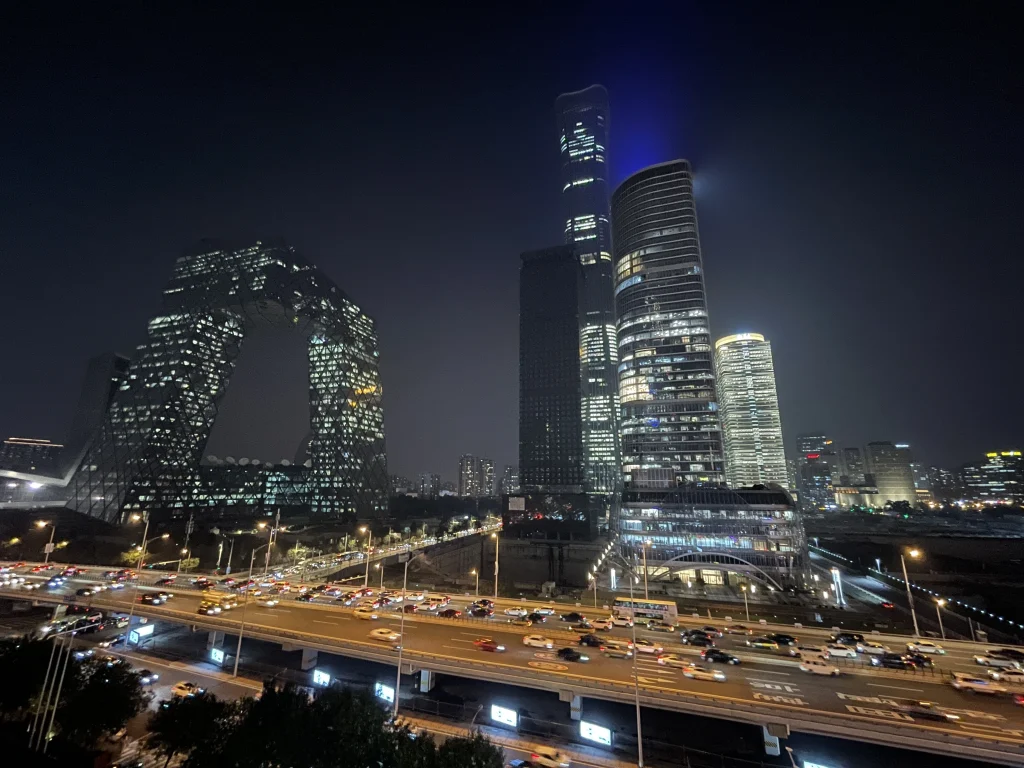
A different development can be traced around Guomao (国贸, Guómào) in eastern Beijing. The China World Trade Center became an important starting point for today’s business district. Construction began in 1985 on the site of a former metalworks; the first phase opened in 1990 with offices, hotels and facilities for trade and international business relations. Where manufacturing had once taken place, services and international companies now grew in importance.
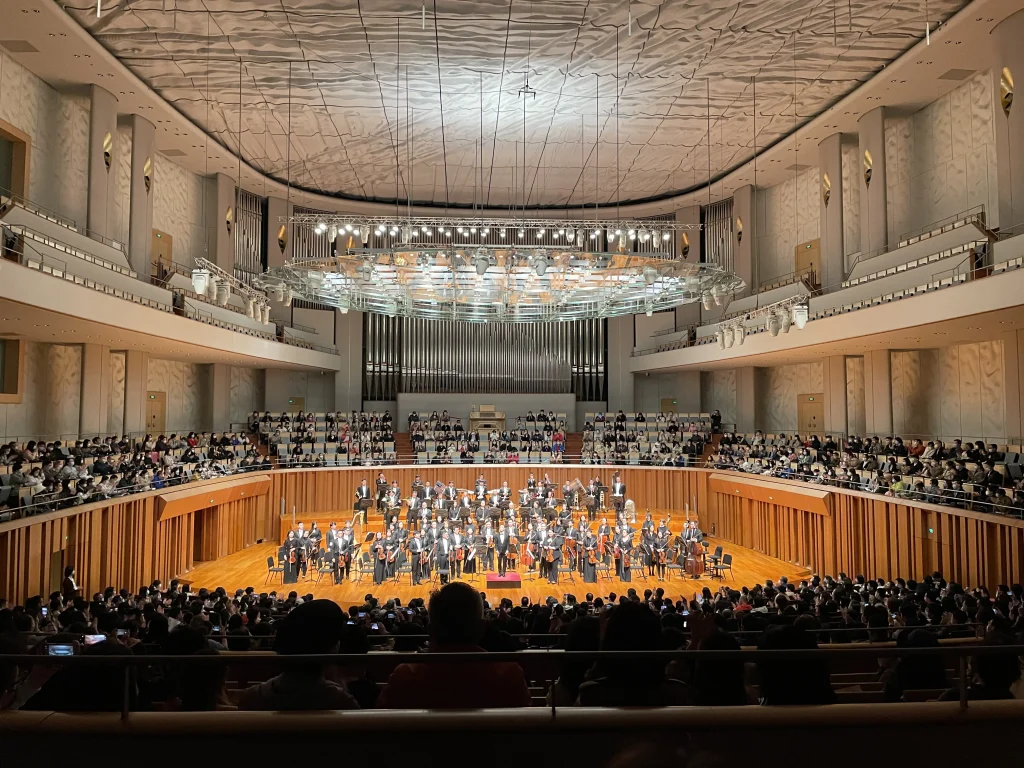
Particularly since the 2000s, the district has developed into a major business hub with corporate headquarters, financial services companies, hotels and shopping centres. The 330-metre China World Tower opened in 2010. The distinctive CCTV Headquarters, with its connected, leaning towers, was completed in 2012. Completed in 2018, the CITIC Tower, also known as China Zun (中国尊, Zhōngguó Zūn), rises above the district at 528 metres. Today, some of Beijing’s best shopping malls are located here. The National Centre for the Performing Arts also belongs in this view of the city, its modern architecture showing how Beijing is shaping its role as a cultural centre today.
This shift in perspective on the city’s history is worthwhile on a travel to Beijing. After the palace courtyards, 798 and Guomao show you how Beijing has developed into an international business centre alongside its political and cultural roles.
My Personal Conclusion: The History of Beijing Makes Your Travel More Meaningful
After three years of living there, Beijing is a second home to me. That’s precisely why I want to understand more about how the city became what it is today, and to share that background.
What particularly fascinates me is how clearly the centuries-old layout is still visible in today’s centre. The north–south axis connects the city’s planning with the layout of the Forbidden City. From Jingshan, you can see this arrangement as a whole. And at Tian’anmen Square, different ideas of how a capital expresses power and significance meet.
For your travel to Beijing, the value lies above all in these connections of the city’s history. The Forbidden City shows how imperial rule found expression in physical space. The Temple of Heaven explains the emperor’s ritual role, and the waterways recall how the capital was supplied.
If you’d like to turn these ideas into an itinerary, you’ll find the relevant places in my overview of the sights in Beijing.
Which part of the history of Beijing interests you most? And was there a place on your travel that you suddenly saw differently once you knew a little of its background? Let me know in the comments!